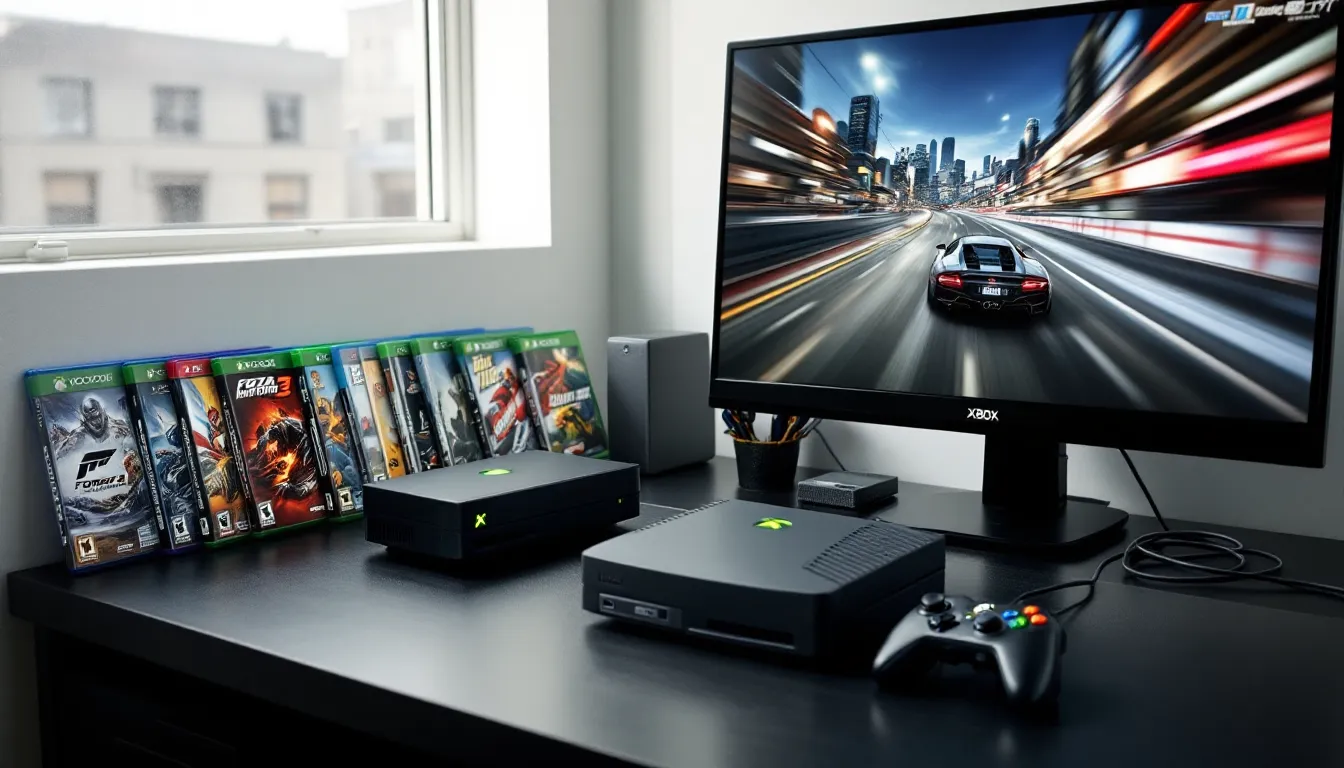
The original Xbox doesn’t get enough credit for what it did to racing games. Between 2001 and 2006, Microsoft’s big black console delivered some of the genre’s most influential titles, games that laid the groundwork for modern racing franchises and introduced features we now take for granted. While everyone was busy arguing about PS2’s library size or GameCube’s first-party exclusives, the Xbox quietly built a racing catalog that punched way above its weight.
What made the original Xbox special wasn’t just the games themselves, but how they leveraged the system’s capabilities. The built-in hard drive allowed for custom soundtracks, so you could tear through Chicago streets to your own music instead of whatever the devs picked. The Ethernet port made Xbox Live the first console platform where online racing actually worked consistently. And that custom GPU? It pushed detail and effects that made competitors look last-gen.
This guide covers the essential racing games that made the original Xbox worth owning, from household names to overlooked gems that deserve another look in 2026.
Key Takeaways
- Original Xbox racing games revolutionized the genre between 2001 and 2006 by introducing innovations like custom soundtracks via the built-in hard drive and reliable online multiplayer through Xbox Live.
- Project Gotham Racing 2 and Forza Motorsport defined Xbox’s racing identity by balancing arcade accessibility with competitive depth, launching franchises still relevant today.
- The original Xbox racing catalog diversified across multiple subgenres—simulation with Forza, arcade action with Burnout 3, rally excellence with Rallisport Challenge, and motorcycle racing with MotoGP—proving the platform’s versatility.
- Rallisport Challenge 2 and other Xbox racing titles aged well due to prioritized art direction and performance optimization rather than pursuing raw graphical power.
- Playing original Xbox racing games today requires either original hardware (with clock capacitor concerns on older models), component cables with display upscalers, or tracking backward-compatible titles on newer Xbox consoles.
- Collecting original Xbox racing games remains affordable, with most common titles costing $10–$30 complete, though certain exclusives and special editions command $60–$120 premiums.
Why the Original Xbox Was a Racing Game Powerhouse
Microsoft entered the console market with something to prove, and they knew racing games would be crucial. The genre shows off hardware capabilities better than almost anything else, draw distance, texture quality, frame rates, physics calculations. Xbox had the muscle to flex in all those areas.
The built-in 8GB hard drive changed everything for racing games. Instead of relying on disc reads for track data, games could install portions to the HDD and eliminate loading screens or dramatically reduce them. More importantly, custom soundtracks became standard. Pop in your own CDs, rip them to the console, and suddenly every racing game had your personal playlist. It sounds like a small feature now, but in 2002 it was revolutionary.
Xbox Live launched in November 2002 and immediately gave racing games a competitive edge over PlayStation 2’s fragmented online attempts. Project Gotham Racing 2, MotoGP 2, and later titles supported proper matchmaking, leaderboards, and voice chat. You weren’t just racing against AI anymore, you were competing against real players across the country, trash-talking through that massive controller’s headset port.
The technical specs mattered too. That 733MHz Intel CPU and custom Nvidia GPU delivered consistent performance that kept most racing games locked at 30fps, with some hitting 60fps. Tracks looked detailed, car models featured actual depth instead of the flat textures common on PS2, and lighting effects like reflections on wet asphalt actually looked convincing.
Microsoft also understood they needed exclusive partnerships. They funded Bizarre Creations to make Project Gotham Racing an Xbox exclusive. They launched Forza as a direct competitor to Gran Turismo. They secured Rallisport Challenge as a first-party title. These weren’t just ports of existing games, they were built specifically to showcase what Xbox could do.
The Best Original Xbox Racing Games of All Time
Project Gotham Racing Series: Xbox’s Flagship Racing Franchise
Project Gotham Racing and PGR2 defined what Xbox racing could be. Bizarre Creations built these games around the Kudos system, a mechanic that rewarded style points for drifts, drafts, and clean overtakes. You weren’t just trying to finish first: you were trying to look good doing it.
PGR1 launched alongside the Xbox in November 2001 with four cities (Tokyo, San Francisco, London, New York) recreated in impressive detail for the era. The career mode forced you to balance speed with style, since some events required minimum Kudos scores regardless of placement. It felt fresh compared to the pure sim or pure arcade titles dominating the genre.
PGR2 (September 2003) elevated everything. Ten cities, over 100 cars, Xbox Live support with eight-player races, and weather effects that actually impacted handling. Racing through Edinburgh in the rain at night, chaining drifts through narrow streets while trying to maintain enough control to hit the next checkpoint, that was PGR2 at its best. The online community took the Kudos competition seriously, with players perfecting routes to maximize style points.
The series walked the line between simulation and arcade perfectly. Cars had weight and momentum, but you could still pull off exaggerated drifts that would be impossible in Forza. It’s the template that Forza Horizon would later follow, though Horizon leaned harder into open-world freedom.
Forza Motorsport: The Simulation King That Started It All
Forza Motorsport launched in May 2005 as Microsoft’s answer to Gran Turismo. Turn 10 Studios built it specifically to compete with Sony’s flagship sim racer, and in many ways, they succeeded on the first try.
The car list featured 231 vehicles from over 60 manufacturers, with a damage model that actually affected performance, scrape a wall and your alignment suffered. The physics engine prioritized realism without being impenetrable to newcomers. Career mode offered a proper racing ladder where you bought cars, upgraded parts, and specialized in specific classes.
But AI behavior set Forza apart. Opponents made mistakes, defended their positions, and occasionally spun out under pressure. They weren’t just driving the racing line, they were competing. Drivatar technology, even in its early form, learned from player behavior to create more realistic opposition.
Xbox Live leaderboards and ghost data sharing turned Forza into a competitive platform. You could race against the ghosts of the top players on any track, studying their lines and braking points. Time trials became obsessive grinds to shave off hundredths of a second.
Forza also introduced a livery editor that let players create custom paint schemes and share them online. This seems standard now, but in 2005 it was novel, turning car customization into both art project and community feature. The strategy behind building competitive setups rewarded patience and experimentation.
Rallisport Challenge Series: Off-Road Excellence
Rallisport Challenge (February 2002) and Rallisport Challenge 2 (May 2004) remain the best rally games many players have experienced. DICE, yes, the Battlefield studio, developed both titles as Xbox exclusives, and their attention to vehicle physics showed.
The first game offered four rally disciplines: Rally (point-to-point), Ice Racing, Hill Climb, and Rallycross (circuit racing). Each required different approaches. Rally demanded precision and memorization. Ice Racing was chaos management. Hill Climb was a pure time attack up mountain roads. Rallycross combined traditional circuit racing with rally physics and mixed surface types.
Rallisport Challenge 2 refined everything and added spectacular visuals. Mud caked your windshield. Gravel pinged off bodywork. Snow built up on the hood during blizzard stages. The co-driver callouts were clear and accurate enough to actually help. The coverage of racing game evolution documented how these details set new standards.
Both games ran at 60fps, which made the handling feel incredibly responsive. You needed that frame rate, rally racing requires split-second corrections, and input lag would’ve killed the experience. The career modes weren’t revolutionary, but they didn’t need to be. The driving was good enough to carry the game.
Physics struck a nice balance between sim and accessibility. Cars felt heavy and unstable on loose surfaces, but you could still recover from mistakes without instant catastrophic failure. It was punishing enough to be satisfying but forgiving enough to keep you trying.
Burnout Series: Arcade Chaos at Its Finest
Burnout, Burnout 2: Point of Impact, and Burnout 3: Takedown all hit Xbox, with Burnout 3 being the undisputed highlight. Criterion Games built these around speed, destruction, and a risk-reward boost system that kept races tense from start to finish.
Burnout 3: Takedown (September 2004) perfected the formula. The Takedown mechanic let you ram opponents into walls, traffic, or each other to eliminate them from races. Aggressive driving refilled your boost meter. Near-misses with traffic did too. The entire design philosophy encouraged reckless behavior and rewarded it.
Crash mode turned vehicle destruction into puzzle solving. You’d launch a car into intersections full of traffic, trying to cause maximum monetary damage. Strategically placed buses or explosive pickups created chain reactions. It was oddly meditative, a break from the intensity of standard races.
The soundtrack was EA Trax at its peak: punk, alternative rock, and electronic tracks that matched the adrenaline. Custom soundtracks were an option, but Burnout 3’s licensed music fit so well that many players left it on. Much of the game journalism covering Burnout 3 highlighted how the soundtrack elevated the entire experience.
Split-screen and online multiplayer kept the chaos going. Xbox Live Takedown races devolved into beautiful carnage as eight players tried to wreck each other while maintaining enough speed to actually finish.
Arcade-Style Racing Games Worth Playing
MotoGP and Motorcycle Racing Titles
Motorcycle racing carved out its own niche on Xbox with several strong entries. MotoGP (2002), MotoGP 2 (2003), and MotoGP 3 (2005) delivered officially licensed Grand Prix racing with career modes that actually required learning rider transfers, bike setups, and track-specific strategies.
The physics differentiated motorcycle racing from car-based games. Weight transfer mattered more, you couldn’t just brake into corners. Tucking behind fairings for aerodynamics, managing tire wear across race distances, and finding clean lines through crowded first laps created tension that car games couldn’t replicate.
MotoGP 2 integrated Xbox Live early and did it well. Eight-player races, dedicated servers, and community tournaments gave the game longevity. The learning curve was steep enough that skilled players dominated, creating a competitive hierarchy.
MX Unleashed (February 2004) went the motocross route, offering freestyle tricks alongside traditional racing. The career mode included sponsor objectives and rhythm racing events. Physics were exaggerated, bikes caught huge air and tricks defied reality, but it was fun in that early-2000s extreme sports game way. You could explore massive open areas between events, finding hidden collectibles and freestyle spots.
Street Racing Underground Culture Games
The success of The Fast and the Furious films created demand for street racing games with customization focus. Xbox had several entries trying to capture that culture.
Midnight Club II (April 2003) from Rockstar brought open-world street racing to three cities: Los Angeles, Paris, and Tokyo. No invisible walls or restricted courses, you found your own route to checkpoints. Slipstream boost, aggressive AI, and a soundtrack featuring Run-DMC and Scarface made it feel appropriately illegal. Arcade handling kept speeds high and collisions frequent.
Street Racing Syndicate (August 2004) went deeper into customization and culture, though the execution was uneven. Hundreds of licensed aftermarket parts let you tune both performance and appearance. The respect system tied progression to your car’s aesthetic and performance. It tried to incorporate photography of import models as unlockables, which aged poorly and felt exploitative even then.
Juiced (June 2005) focused on crew-based racing and pink-slip gambling. You built a team, managed relationships with rival crews, and wagered cars in high-stakes races. The risk of losing a customized vehicle you’d spent hours tuning added genuine tension. Calendar-based career mode created scheduling pressure, miss an important event and opportunities disappeared.
Hidden Gems and Underrated Racing Titles
Several excellent racing games flew under the radar during Xbox’s lifespan, overshadowed by bigger franchises but worthy of recognition.
RalliSport Challenge spawned a sequel, but the original often gets forgotten even though innovating several mechanics that later games borrowed. Its dynamic weather system altered track conditions mid-race, forcing adaptation. Few rally games before it made weather feel like an actual competitive factor rather than just visual flair.
OutRun 2 (October 2004) and OutRun 2006: Coast 2 Coast (2006) brought Sega’s arcade classic to home consoles with surprising depth. The girlfriend challenges added variety, drifting through specific zones, staying in slipstreams, avoiding traffic while maintaining speed. Career mode featured branching paths through stages just like the arcade original. The 60fps performance and vibrant visuals made it feel like playing an actual arcade cabinet at home.
Shox Rally Reinvented (April 2002) from EA offered a blend of rally racing and stunt driving. The Shox system rewarded aerial tricks and clean landings with time bonuses. Tracks combined point-to-point rally sections with arena-style stunt zones. It never found an audience but tried something different when most racing games stuck to established formulas.
Toca Race Driver 2 (April 2004, titled Race Driver 2 in some regions) delivered touring car racing with a career mode that actually told a story through cutscenes and rivalries. Multiple racing disciplines, touring cars, GTs, open-wheel, rallycross, kept events varied. Damage modeling was brutal: one bad crash could end your race with mechanical failure.
NASCAR Thunder 2003 and 2004 were the peak of console NASCAR sims before the genre declined. Career modes let you build teams, hire crew chiefs, and manage sponsorships across full 36-race seasons. The driving physics balanced accessibility with enough realism to reward proper drafting and tire management. The Xbox versions looked significantly better than PS2 counterparts, with cleaner textures and better draw distance, crucial for racing at 190mph.
World Racing (September 2003) featured a 25,000-kilometer open world across different regions, cities, countryside, industrial zones. The free-roaming mode let you explore between events. It was ambitious but clunky, suffering from generic track design even though the massive scope. Still, the scale impressed when most racing games stuck to discrete circuits.
The diverse racing game archives show how many genres and subgenres thrived during this generation.
Original Xbox Racing Games That Aged Like Fine Wine
Graphics and Performance Innovations
Several Xbox racing games still look surprisingly decent two decades later, largely because developers prioritized performance and art direction over raw polygon counts.
Project Gotham Racing 2 holds up visually because Bizarre Creations focused on lighting and atmosphere. Edinburgh at dusk, Tokyo’s neon-soaked streets, Barcelona’s Mediterranean brightness, the art direction compensated for lower-poly models. The 30fps lock stayed consistent even with weather effects, which mattered more than hitting 60fps with constant frame drops.
Forza Motorsport aged well due to clean, realistic art direction. Cars featured proper specular highlights and reflections. Tracks avoided the over-saturated color palettes common in early-2000s games. The UI was functional and readable, which many contemporary games sacrificed for stylized menus that looked dated within years.
Burnout 3 maintained its appeal through sheer speed and destruction physics. The motion blur and sense of velocity still feel fast in 2026. Criterion’s physics engine made crashes spectacular with debris flying, sparks spraying, and metal crumpling in semi-realistic ways. The exaggerated animations hold up better than games attempting photorealism with 2004 technology.
Rallisport Challenge 2 benefits from environmental detail that didn’t rely on high-resolution textures. The mud effects, weather systems, and vehicle deformation impressed through technique rather than brute-force rendering. DICE’s experience with large-scale environments from Battlefield showed in the track design.
Xbox Live Multiplayer Racing Revolution
Xbox Live transformed racing games from primarily single-player experiences to competitive online platforms. Before Xbox Live, console online racing was a mess of different services, network adapters, and inconsistent implementations.
Project Gotham Racing 2 proved Xbox Live’s potential with smooth eight-player races, minimal lag, and integrated voice chat. The community created informal racing leagues with rules for clean racing versus Kudos-focused chaos. Leaderboards for every track created constant competition, seeing your friend’s time at the top pushed you to improve.
MotoGP 2 built an entire competitive scene around Xbox Live. Regular tournaments, skill-based matchmaking, and ghost data sharing made it serious business for dedicated players. The online community developed meta-strategies for bike setups on specific tracks.
Forza Motorsport used Xbox Live to compensate for limited AI through player ghosts and shared tuning setups. Downloading a top-tier player’s car setup and then racing their ghost on the same track created targeted learning opportunities. You could see exactly where you lost time and what lines worked best.
The friends list integration made spontaneous online racing common. Jump online, see which friends were racing, join their session. No friend codes, no complicated setup, just functional online play that worked consistently.
Compared to the fragmented mess of PlayStation 2’s online implementation or GameCube’s nonexistent online infrastructure, Xbox Live made multiplayer racing accessible and reliable. That single Ethernet port and Microsoft’s centralized service gave Xbox a massive advantage.
How to Play Original Xbox Racing Games Today
Backward Compatibility Options
Playing original Xbox racing games in 2026 depends on which Xbox console you own and whether your specific titles received backward compatibility support.
Xbox 360 backward compatibility was limited and inconsistent. Only 461 original Xbox games worked on 360, and the list included some racing titles but not all. Forza Motorsport, Burnout 3, Project Gotham Racing 2, and both Rallisport Challenge games made the compatibility list. But, performance varied, some games had frame rate issues or graphical glitches not present on original hardware.
Xbox One and Xbox Series X/S support is even more limited. Microsoft hasn’t expanded original Xbox backward compatibility significantly since ending the program in 2019. Currently, only a handful of original Xbox racing games work on modern consoles. The emulation layer on Series X/S offers enhanced visuals and performance when games are supported, but most racing games from the original Xbox aren’t available this way.
The titles that are backward compatible often see resolution bumps and more stable frame rates on Series X/S. Burnout 3 runs at higher resolution with improved texture filtering. But major titles like the Project Gotham Racing series remain unplayable on modern Xbox hardware due to licensing issues with cars, tracks, and music.
One significant hurdle: online multiplayer for original Xbox games no longer functions. Xbox Live for original Xbox was shut down in April 2010. Even if you’re playing on original hardware or through backward compatibility, you’re limited to single-player and local multiplayer.
Original Hardware and Preservation
Playing on original Xbox hardware remains the most authentic option, though it requires some effort in 2026.
Original Xbox consoles are cheap and plentiful at retro game stores, eBay, and Facebook Marketplace, typically $50-$100 depending on condition. Look for revised models (manufactured after 2003) that removed the clock capacitor issue which caused earlier units to fail.
The clock capacitor problem is worth understanding: original Xbox motherboards included a capacitor that maintained system time. In 1.0-1.5 revision consoles, this capacitor leaks over time, corroding the motherboard and eventually killing the system. Revised 1.6 models used a different capacitor that doesn’t leak. If you’re buying an older model, the capacitor should be removed immediately, tutorials are readily available online.
Controller options have improved. Original Duke and Controller S units still work fine, but third-party companies now make USB adapters for modern controllers. Some enthusiasts prefer playing with Xbox 360 or Xbox One controllers through these adapters.
Display compatibility can be tricky. Original Xbox outputs component video at 480p/720p/1080i depending on the game. You’ll need either a CRT TV with component inputs, an HDTV with component support, or an upscaler like the RetroTINK or mClassic to convert to HDMI. Component cables for Xbox are cheap and produce decent image quality.
Game preservation faces challenges. Original Xbox discs are aging, and some have begun suffering from disc rot. Creating backup copies through soft-modded consoles has become common in the preservation community, though legality varies by region. Prices for popular racing games have remained reasonable, most cost $10-$30 complete in box.
Soft-modding (installing custom software to run homebrew and backups) is relatively straightforward with the right tools. Resources at retro gaming communities document the process. This allows playing backup copies from the hard drive, eliminating disc drive wear and loading times.
Collecting Original Xbox Racing Games in 2026
The collecting scene for original Xbox racing games sits in a sweet spot: affordable enough to build a complete collection, but rare enough that certain titles command premium prices.
Common titles remain cheap. Burnout 3, Forza Motorsport, Project Gotham Racing, and Midnight Club II typically cost $10-$20 complete. They sold well and plenty of copies circulate. Don’t expect these to appreciate significantly, supply exceeds demand.
Mid-tier collectibles include the Rallisport Challenge games ($25-$40), OutRun 2006: Coast 2 Coast ($30-$50), and MotoGP titles ($15-$30). These had smaller print runs or specific appeal to genre fans, keeping prices slightly elevated.
Rare and expensive games exist but aren’t racing-focused except for a few outliers. Street Racing Syndicate sealed copies have climbed to $80-$120 due to low production numbers. Juiced special editions with bonus discs occasionally hit $60-$80. Most racing games don’t command these prices, but limited editions and promotional copies can surprise collectors.
Regional variations matter. PAL region exclusive titles like TOCA Race Driver series entries sometimes didn’t receive US releases, making imports necessary for complete collections. Japanese exclusives are rare in the racing genre since most major franchises had worldwide releases.
Condition grading affects value as always. Complete in box (CIB) with manual commands a premium over disc-only. Original Xbox cases are notorious for cracked hinges, finding intact cases adds value. Sealed games have appreciated faster, but racing games aren’t seeing the dramatic increases common in RPGs or platform-specific exclusives.
What to prioritize if you’re starting a collection:
- Project Gotham Racing 2 and Forza Motorsport, essential titles that defined Xbox racing
- Rallisport Challenge 2, increasingly recognized as a standout rally game
- Burnout 3: Takedown, still beloved and historically significant
- OutRun 2006: Coast 2 Coast, climbing in value as Sega arcade ports gain appreciation
- MotoGP series, niche but complete the motorcycle racing subset
Avoid buying from third-party sellers on Amazon, prices are inflated compared to eBay, retro stores, or local marketplaces. Facebook Marketplace and Craigslist often have bulk lots where racing games get bundled cheaply with other titles.
Preservation considerations: Original Xbox discs use standard DVD media, which degrades over time. Store games vertically in climate-controlled spaces away from direct sunlight. High humidity and temperature fluctuations accelerate deterioration. Consider creating backups of rare titles if you have the technical capability.
Conclusion
The original Xbox’s racing library deserves more recognition than it typically receives. Between 2001 and 2006, Microsoft’s console hosted genre-defining titles that introduced mechanics, features, and online functionality that modern racing games still build upon.
Project Gotham Racing proved style and speed could coexist. Forza Motorsport launched a simulation franchise that still competes with Gran Turismo two decades later. Rallisport Challenge delivered rally racing that hasn’t been matched by many games since. Burnout 3 perfected arcade destruction racing. These weren’t just good games for their time, they established templates the genre still follows.
Whether you’re revisiting these games through original hardware, hunting for collectibles, or discovering them for the first time, the original Xbox racing catalog offers depth and variety. Not every title aged perfectly, and licensing issues have trapped some excellent games in the past without backward compatibility. But for those willing to track down working hardware or compatible versions, there’s a generation of racing games worth experiencing beyond modern releases.
The built-in hard drive, Xbox Live integration, and technical capabilities gave developers tools to experiment and innovate. The results defined a generation and influenced everything that came after.


