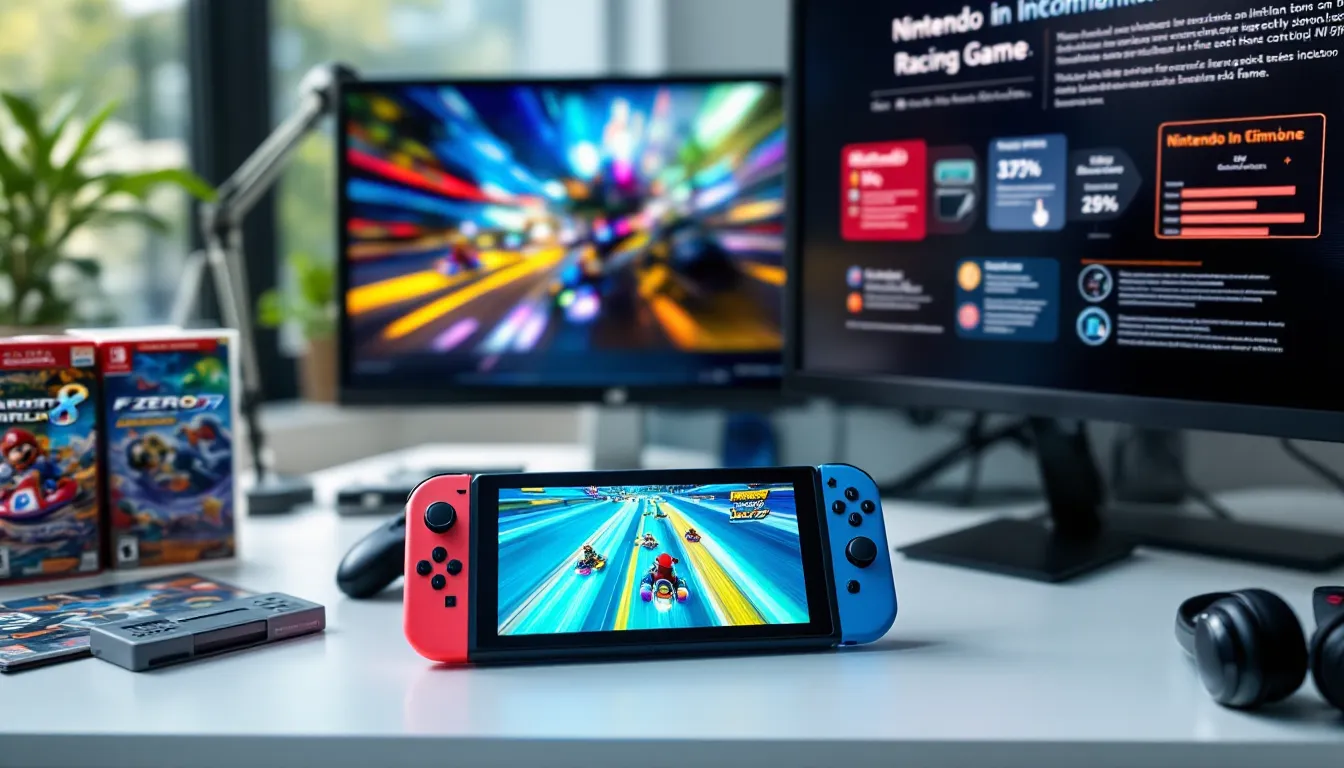
Nintendo’s relationship with racing games spans four decades of innovation, nostalgia, and adrenaline. From the chaos of banana peels on Rainbow Road to the blistering 1,000 km/h speeds of Captain Falcon’s Blue Falcon, Nintendo has shaped how generations experience competitive racing. Whether you’re hunting for that perfect drift in Mario Kart 8 Deluxe or wondering if F-Zero will ever return to its former glory, this guide breaks down every major racer in Nintendo’s catalog, plus the third-party gems that found a home on the Switch.
This isn’t just a trip down memory lane. With the Booster Course Pass wrapping up in 2023, F-Zero 99 bringing battle royale mayhem in late 2023, and persistent rumors about Mario Kart 9 and Nintendo’s next console, 2026 is a pivotal year for Nintendo racing. Here’s everything you need to know about the franchise titans, the forgotten classics, and what’s coming next.
Key Takeaways
- Nintendo racing games balance accessibility with competitive depth, allowing casual players and speedrunners to enjoy the same experience through mechanics like rubber-banding AI and advanced drift techniques.
- Mario Kart 8 Deluxe has sold over 60 million copies on Switch and remains the definitive racing experience, with the Booster Course Pass expanding its track library to 96 courses by 2023.
- F-Zero 99’s 2023 launch as a battle royale exclusive revived interest in the dormant franchise after 19 years, proving Nintendo’s willingness to experiment with beloved IPs despite mixed reactions from purists.
- Classic titles like Mario Kart: Double Dash and F-Zero GX showcase innovative mechanics—dual racers and extreme difficulty respectively—that have never been fully replicated in subsequent Nintendo racing games.
- Nintendo’s next console (rumored for 2026-2027) could transform racing games with 4K graphics, improved online infrastructure, and ray-traced environments that enhance high-speed franchises like F-Zero.
- Third-party racers like Crash Team Racing Nitro-Fueled prove Switch can host diverse racing experiences, though technical compromises like 30fps performance highlight trade-offs between portability and performance.
The Legacy of Nintendo Racing Games
Why Nintendo Dominates the Racing Genre
Nintendo carved out a unique lane in racing games by prioritizing accessibility without sacrificing depth. While simulation racers like Gran Turismo and Forza chase realism, Nintendo built empires on chaos, personality, and pick-up-and-play design. Mario Kart became the best-selling racing franchise of all time by letting anyone compete, grandma, hardcore speedrunners, and everyone in between.
The secret? Rubber-banding AI, item-based comebacks, and track design that rewards both skill and luck. A blue shell might frustrate competitive players, but it keeps casual matches unpredictable. Meanwhile, advanced techniques like fire-hopping, snaking, and ultra mini-turbos give veterans room to optimize. That balance is why Mario Kart 8 Deluxe moved over 60 million units on Switch alone as of early 2024.
Beyond Mario Kart, Nintendo experimented with futuristic anti-gravity in F-Zero, aquatic racing in Wave Race, and motorcycle mayhem in Excitebike. Each franchise targeted different player fantasies, speed demons, trick enthusiasts, off-road junkies, and most nailed their niche.
Evolution from SNES to Nintendo Switch
The SNES era launched two legends: Super Mario Kart (1992) introduced Mode 7 pseudo-3D racing and local multiplayer chaos, while F-Zero (1990) showcased the console’s graphical power with blistering speed. Both franchises defined their genres but took wildly different paths.
The N64 brought Mario Kart 64 and Diddy Kong Racing into true 3D, while F-Zero X (1998) pushed 60fps racing with 30-car grids. GameCube’s F-Zero GX (2003) perfected the formula with Sega’s arcade expertise, but the series vanished afterward, no new mainline F-Zero for over two decades.
The Wii era leaned into motion controls with Mario Kart Wii and Excitebike: World Rally, experimenting with accessibility. The Wii U stumbled commercially, but Mario Kart 8 (2014) introduced anti-gravity mechanics and stunning HD visuals that would carry the franchise into the Switch generation.
Switch unified Nintendo’s racing legacy. Mario Kart 8 Deluxe became the definitive version, F-Zero 99 revived the dormant franchise as a battle royale experiment, and the eShop welcomed retro ports alongside third-party racers. The hybrid form factor made local multiplayer portable again, recapturing the magic of SNES link cables and N64 split-screen sessions.
Mario Kart Series: The Crown Jewel of Nintendo Racing
Mario Kart 8 Deluxe and the Booster Course Pass
Mario Kart 8 Deluxe launched with the Switch in 2017 and never stopped growing. The base game included 48 tracks, all DLC from the Wii U version, a revamped Battle Mode, and quality-of-life tweaks like holding two items simultaneously.
The Booster Course Pass (2022-2023) added 48 remastered tracks from across franchise history, mobile, arcade, and legacy console entries. Wave 6 dropped in late 2023, bringing the total track count to 96. Highlights include Merry Mountain from Mario Kart Tour, Peach Gardens from DS, and Rainbow Road (3DS) with its glider-heavy layout.
Not all remasters hit the same quality bar. Some tracks like Coconut Mall sparked debate over simplified visuals and removed obstacles, while others like Waluigi Pinball nailed the nostalgia. Competitive players appreciated the variety but noted inconsistent item balance across older track designs.
As of 2026, MK8D remains the go-to Mario Kart experience. The 200cc mode demands brake-drifting mastery, smart mini-turbo chains separate casual from competitive play, and the vehicle customization meta still revolves around combinations like Waluigi + Wiggler + Roller + Cloud Glider for optimal speed-weight ratios.
Classic Mario Kart Titles Worth Revisiting
Every mainline Mario Kart brought something unique:
-
Super Mario Kart (SNES, 1992): The origin. Flat sprites on Mode 7 tracks, brutal AI, and the birth of Rainbow Road. Nintendo Switch Online makes this accessible again, though the physics feel stiff by modern standards.
-
Mario Kart 64 (N64, 1996): 3D racing, four-player split-screen, and iconic shortcuts like Koopa Troopa Beach’s wall skip. Battle Mode peaked here with Block Fort and Double Deck.
-
Mario Kart: Double Dash.. (GameCube, 2003): The wildcard. Two racers per kart, character-specific items like Chain Chomps and Giant Bananas, and the best co-op experience in the series. Never replicated, often requested for a remake.
-
Mario Kart DS (2005): Online multiplayer debut, mission mode, and snaking, a controversial exploit where rapid mini-turbos let skilled players dominate. Tight tracks like Tick-Tock Clock and Waluigi Pinball became franchise staples.
-
Mario Kart Wii (2008): The best-selling entry (37+ million copies) thanks to bundled Wii Wheels and motion controls. Bikes introduced wheelies for speed boosts, and Funky Kong + Flame Runner ruled online lobbies. Custom Track distributions from the modding community keep this alive in 2026.
-
Mario Kart 7 (3DS, 2011): Gliding and underwater sections debuted here, plus kart customization. Maka Wuhu had a notorious glitch shortcut that plagued online races until patches.
Each title offers distinct physics, metas, and communities. Speedrunners and retro enthusiasts keep older entries competitive, especially Double Dash and Wii.
F-Zero: The High-Speed Sci-Fi Racing Phenomenon
F-Zero 99 and the Series Revival
After 19 years of silence, F-Zero 99 launched in September 2023 exclusively for Nintendo Switch Online subscribers. This battle royale racer pits 99 players against each other on classic SNES tracks, combining elimination mechanics with signature F-Zero speed.
Players earn Super Spark energy by hitting rival machines, which fuels speed boosts and special attacks. Skyway sections let racers fly above the chaos temporarily, while KO’d players become obstacles for survivors. The last racer standing wins, but finishing laps also matters, aggressive players can dominate early, while patient drivers survive the carnage.
The game revived interest in F-Zero, but reactions were mixed. Purists wanted a full 3D sequel, not a retro battle royale. Still, F-Zero 99 proved the franchise still has an audience. Nintendo’s willingness to experiment with the IP after decades of dormancy sparked hope for something bigger.
Community tournaments emerged quickly, with strategies revolving around Blue Falcon (balanced), Golden Fox (acceleration), Wild Goose (durability), and Fire Stingray (top speed). Meta players favor aggressive early KOs to thin the herd before final laps.
Why F-Zero GX Remains a Cult Classic
F-Zero GX (2003) for GameCube is the pinnacle of the franchise, and one of the hardest racing games ever made. Developed by Sega’s Amusement Vision (creators of Super Monkey Ball), GX pushed 60fps with 30 racers, insane speed, and punishing difficulty.
The Story Mode is legendary for its brutal challenges. Master difficulty missions like “Chapter 7: Finale” require pixel-perfect racing and absurd risk-taking. Failing a mission 50+ times isn’t uncommon, but conquering them feels like earning a PhD in racing.
Vehicle customization lets players craft machines prioritizing body (durability), boost (top speed), or grip (handling). The Fire Stingray dominates time trials with maxed acceleration and speed but explodes on contact. Meanwhile, Fat Shark tanks hits but handles like a semi-truck.
GX’s arcade roots show in its risk-reward boost system. Boosting drains your energy meter, crash or over-boost, and you explode. Side-attacking rivals, hitting boost pads, or drifting through corners at 1,200 km/h demands frame-perfect inputs.
Why hasn’t Nintendo ported or remastered GX? Sega co-developed it, complicating rights. Fans have begged for a Switch port or sequel, especially after detailed retrospectives on why the game aged so well highlighted its physics and design philosophy. Until then, GX remains locked on GameCube and Wii (via backward compatibility), fetching premium prices on the used market.
Hidden Gems and Underrated Nintendo Racers
Diddy Kong Racing: More Than a Mario Kart Clone
Diddy Kong Racing (1997) for N64 often gets dismissed as a Mario Kart knock-off, but it innovated in ways Mario Kart didn’t match for years. It featured an adventure mode with boss battles, hub worlds, and progression gating, beating Wizpig required mastering every track and vehicle type.
Players could choose karts, hovercrafts, or planes depending on the track, adding strategic variety. Each vehicle handled differently: karts drifted tight, planes soared over obstacles, and hovercrafts glided across water. The weapon system introduced balloons that powered up through collection, grab three red balloons for a homing missile instead of a single weak projectile.
The roster introduced Banjo before Banjo-Kazooie launched, plus Conker before his M-rated reinvention. Timber’s Island became a beloved hub world, and tracks like Hot Top Volcano and Star City rivaled Mario Kart’s creativity.
The DS remake (2007) updated visuals and added online play but swapped Banjo and Conker due to licensing (Microsoft owned Rare by then). Both versions hold up, though the N64 original has the stronger speedrunning community.
Wave Race, Excitebike, and Other Forgotten Franchises
Nintendo experimented with racing beyond karts and anti-gravity ships. These franchises deserve more love:
Wave Race 64 (1996) and Wave Race: Blue Storm (GameCube, 2001): Jet ski racing with realistic water physics for the era. Players navigated buoys, performed tricks, and battled dynamic wave conditions. The relaxing vibe and fluid controls made these standout launch titles, but the series vanished after Blue Storm.
Excitebike 64 (2000): The SNES classic went 3D with massive jumps, trick systems, and track editors. Players built custom courses and shared them via Controller Pak. The series briefly returned with Excitebike: World Rally (WiiWare, 2009) and Excitebike Arena (3DS, 2016), but neither captured the N64 magic.
1080° Snowboarding (N64, 1998) and 1080° Avalanche (GameCube, 2003): Extreme snowboarding with realistic physics and steep learning curves. Avalanche added avalanche-dodging mechanics and stunning visuals but couldn’t compete with SSX’s arcade flair.
Kirby Air Ride (GameCube, 2003): The ultimate casual racer. No acceleration button, Kirby auto-accelerates, and players focus on charging boosts, copying abilities, and smashing rivals. City Trial mode became a cult favorite: players explore a city collecting power-ups before a random final event. Speedrunners still optimize City Trial strategies in 2026.
These franchises occasionally appear in Nintendo Switch Online libraries or as retro references, but full revivals remain unlikely unless Nintendo commits to experimental mid-budget releases.
Third-Party Racing Games That Shine on Nintendo Platforms
Crash Team Racing Nitro-Fueled on Switch
Crash Team Racing Nitro-Fueled (2019) brought Activision’s beloved kart racer to modern platforms, including Switch. This full remake of the 1999 PlayStation classic added Crash Nitro Kart content, online multiplayer, and seasonal Grand Prix events with new tracks and characters.
The handling demands precision, perfect power-sliding and boost chaining separate casual players from podium finishers. Unlike Mario Kart’s forgiving drifts, CTR requires releasing and re-initiating slides at exact intervals to maintain Sacred Fire boosts (persistent speed boosts from turbo pads).
Switch performance was controversial. The game ran at 30fps in docked and handheld modes, while PS4 and Xbox One hit 60fps. Input lag and occasional frame drops frustrated competitive players, though patches improved stability. Even though technical compromises, CTR Nitro-Fueled proved third-party kart racers could thrive on Nintendo hardware.
Need for Speed, Cruis’n, and Arcade Ports
The Switch eShop hosts a surprising variety of third-party racers:
Cruis’n Blast (2021): An arcade port from Raw Thrills, the spiritual successor to the N64 Cruis’n trilogy. Pure arcade chaos, drift through traffic, launch off ramps, and race against dinosaurs and UFOs. No realism, just dumb fun with local multiplayer.
Need for Speed: Hot Pursuit Remastered (2020): Criterion’s 2010 classic remastered for Switch. Open-world police chases and exotic car racing at 30fps. Not the best version technically, but portable NFS filled a niche.
Grid Autosport (2019): Codemasters’ 2014 sim racer ported surprisingly well. Realistic handling, career mode, and solid performance. A rare serious racing sim on Switch that appealed to players craving deeper mechanical complexity than typical arcade ports.
Fast RMX (2017): A Switch launch title that channeled F-Zero and Wipeout. Anti-gravity racing at 60fps with phase-switching mechanics (matching ship color to track boosts). Gorgeous visuals and tight controls, though single-player content ran thin.
Hotshot Racing (2020): Retro-styled arcade racer with drift-heavy gameplay and vibrant low-poly aesthetics. Four-player split-screen made it a solid party option.
Third-party racers on Switch rarely match first-party polish, but they offer variety, simulations, arcade throwbacks, and experimental indies that fill gaps Nintendo ignores.
Competitive Play and Online Racing on Nintendo Switch
Best Mario Kart Strategies for Ranked Matches
Mario Kart 8 Deluxe doesn’t have traditional ranked modes, but online regional/worldwide races generate VR (versus rating) scores. Top players hit 30,000+ VR by mastering fundamentals and exploiting advanced techniques.
Vehicle meta (as of 2026):
- Speed builds: Waluigi/Wario + Wiggler/Mercedes GLA + Roller + Cloud Glider maximize speed-weight for frontrunning.
- Acceleration builds: Baby characters + Biddybug + Azure Roller + Paper Glider for recovery after hits.
- Balanced: Medium characters + Wild Wiggler + Slim tires + MKTV Parafoil.
Advanced techniques:
- Mini-turbo optimization: Chain drifts around every corner. Orange sparks (super mini-turbo) are mandatory: pink sparks (ultra mini-turbo) separate elites.
- Brake drifting (200cc): Tap brake mid-drift to sharpen turns without losing speed.
- Mushroom stacking: Hold mushrooms for shortcuts or defensive dodging. Use them to avoid blue shells by timing a mushroom boost at impact.
- Smart item usage: Hold defensive items (bananas, shells) behind your kart. Drag defensive items into item boxes to cycle inventory while staying protected.
- Coin priority: Coins boost top speed (max 10). Grab them aggressively early-race, but avoid them when holding defensive items.
Track knowledge: Memorize shortcuts like Rainbow Road (N64) fence hop, Grumble Volcano mushroom cuts, and Wario Stadium DS glider ramp skips. Online lobbies punish players who don’t optimize racing lines.
Dealing with RNG: Blue shells and lightning are equalizers, but smart players minimize exposure, stay in 2nd until the final lap if possible, bait out items before key shortcuts, and always assume someone behind you has a red shell.
Setting Up Online Tournaments and Lobbies
Mario Kart 8 Deluxe supports custom tournaments via Tournament Mode, accessible from the online menu. Organizers can customize:
- Race settings: Engine class (50cc-200cc), teams on/off, items (normal, shells only, bananas only, etc.).
- Track selection: Random, choose, or in order.
- Scheduling: Tournaments can run 24/7 or during specific windows.
- Codes: Share 12-digit tournament codes for private lobbies.
Competitive communities on Discord, Reddit, and Twitch organize weekly tournaments with rule sets like no items, 200cc, and specific vehicle restrictions. Some ban certain builds to encourage variety.
Voice chat workaround: Nintendo’s limited voice chat frustrates competitive teams. Most use Discord alongside gameplay, though the Nintendo Switch Online app technically supports voice for friends.
Lag mitigation: Wired LAN adapters (via USB) drastically reduce lag compared to Wi-Fi. Serious players invest in Ethernet setups, especially for 200cc where frame-perfect inputs matter.
Spectator features remain absent, limiting tournament broadcasting. Streamers rely on capture cards and OBS overlays to showcase competitive matches professionally.
What to Expect from Nintendo Racing Games in 2026 and Beyond
Rumors and Leaks: Mario Kart 9 and F-Zero’s Future
Mario Kart 9 is overdue. Mario Kart 8 Deluxe dominated the Switch lifecycle, but fans crave a true sequel. Rumors circulating in late 2025 and early 2026 point to MK9 as a cross-generation launch title for Nintendo’s next console (codenamed “Switch 2” or “Nintendo NX2” in leaks, though nothing is confirmed).
Speculation includes:
- Expanded roster: 50+ racers, possibly including non-Mario characters (Link, Splatoon Inklings were teased in MK8).
- Track evolution: Dynamic weather, destructible environments, or branching paths mid-race.
- New mechanics: Some insiders suggest a grappling hook or customizable kart abilities, though these remain unverified.
- Live-service elements: Seasonal content drops, battle passes, or persistent progression systems, divisive ideas among core fans.
No official announcement as of March 2026, but Nintendo typically reveals flagship titles close to hardware launches. If a new console drops in late 2026 or 2027, expect MK9 news soon.
F-Zero’s future hinges on F-Zero 99’s performance. Nintendo rarely commits to dormant franchises without proven demand. If F-Zero 99 maintained strong engagement through 2024-2026, a new entry becomes plausible. Analysis from industry watchers tracking Nintendo’s retro revivals suggests Nintendo tests waters with low-risk experiments (like F-Zero 99) before greenlighting full sequels.
Fans want F-Zero GX 2 or a spiritual successor with modern graphics, online multiplayer, and brutal difficulty intact. Whether Nintendo delivers remains uncertain, but the franchise isn’t dead, it’s dormant, waiting for the right moment.
How the Next Console Could Transform Racing Games
Nintendo’s next console (unannounced but heavily rumored for 2026-2027) will likely push technical boundaries Nintendo ignored during Switch’s lifecycle. Speculation based on industry trends and Nintendo’s patent filings:
4K docked, 1080p handheld: Higher resolutions would benefit fast-paced racers like F-Zero, where visual clarity at extreme speeds matters.
Ray tracing and advanced lighting: Imagine Rainbow Road with real-time reflections or F-Zero tracks with photorealistic Mute City neon.
Expanded online infrastructure: Better netcode, dedicated servers, and integrated voice chat could elevate competitive racing. Nintendo’s historically weak online systems desperately need upgrades.
Backwards compatibility: If the next console runs Switch games natively, MK8D’s lifespan could extend another generation, or fragment the player base between old and new titles.
VR support: Nintendo filed VR-related patents, though whether they commit to VR racing (like Mario Kart VR arcade units) for home consoles is doubtful. F-Zero in VR at 1,000 km/h would be exhilarating, or nausea-inducing.
Whatever Nintendo’s next move, racing games will remain central. Mario Kart is a system-seller, and reviving dormant IPs like F-Zero, Wave Race, or Excitebike could differentiate new hardware from competitors. The question isn’t if Nintendo continues racing games, it’s how boldly they innovate.
Conclusion
Nintendo racing games defined childhoods, sparked friendships, and turned living rooms into battle zones. From Mario Kart’s blue shell rage to F-Zero’s unforgiving speed, these games blend accessibility with depth in ways few franchises match. Whether you’re grinding VR in MK8D, surviving F-Zero 99’s chaos, or revisiting Double Dash’s co-op brilliance, Nintendo’s racers deliver.
2026 sits at a crossroads. Mario Kart 9 rumors swirl, F-Zero teases a comeback, and Nintendo’s next console looms on the horizon. The legacy is secure, what comes next could redefine it. Keep those drift chains tight, and watch for announcements. The next generation of Nintendo racing is closer than you think.


