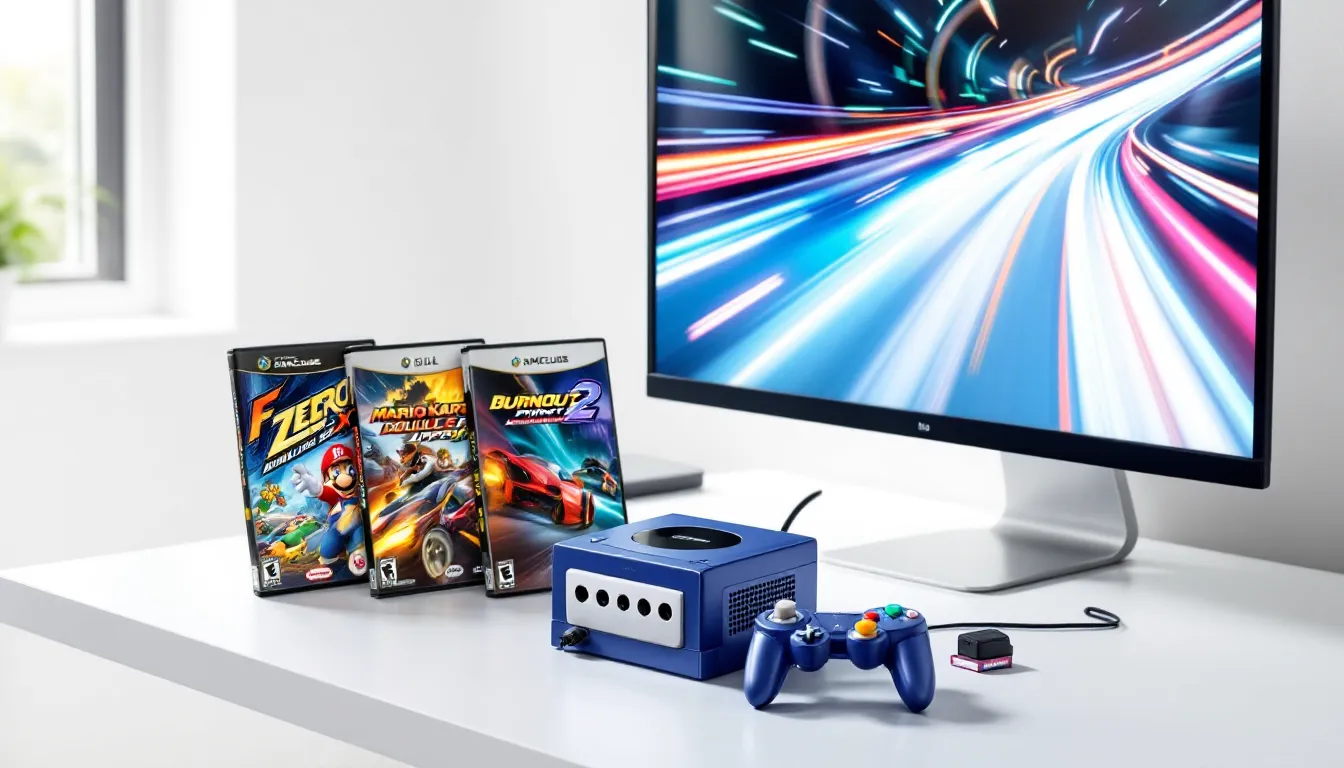
The GameCube doesn’t always get the respect it deserves in the pantheon of racing game platforms. Sandwiched between the PS2’s massive library and Xbox’s Live-enabled future, Nintendo’s quirky cube delivered some of the most memorable, mechanically tight racing experiences of the sixth console generation. From the breakneck speed of F-Zero GX to the party chaos of Mario Kart: Double Dash.., the GameCube’s racing lineup offered something for everyone, whether you wanted precision sim handling, arcade mayhem, or split-screen carnage with friends.
This guide dives into the GameCube’s racing catalog with the specificity it deserves: the best titles that defined the era, the hidden gems that slipped under the radar, and how these games hold up two decades later. Whether you’re hunting down physical copies for original hardware or setting up emulation, here’s everything you need to know about GameCube racing games.
Key Takeaways
- GameCube racing games like F-Zero GX and Mario Kart: Double Dash.. delivered mechanically tight, 60 FPS experiences that remain competitive with modern racers two decades later.
- Mario Kart: Double Dash..’s dual-character mechanic and F-Zero GX’s frame-perfect gameplay created unique experiences that haven’t been replicated in subsequent franchise entries.
- GameCube racing games prioritized local multiplayer with four controller ports, making them ideal for split-screen couch competition without requiring online connectivity or seasonal content.
- Hidden gems like Auto Modellista, Speed Kings, and R: Racing Evolution offered distinct approaches to racing, from cel-shaded sim handling to open-world motorcycle exploration.
- Playing GameCube racing games today is accessible through affordable original hardware with component cables, or through Dolphin Emulator at up to 4K resolution with enhanced graphics.
- The GameCube’s racing catalog ranged from arcade-focused titles (Kirby Air Ride, Burnout 2) to simulation-leaning experiences (NASCAR Thunder 2003), offering options for every skill level and preference.
Why the GameCube Era Was a Golden Age for Racing Games
The GameCube launched in 2001 into a competitive landscape where racing games were transitioning from arcade-style simplicity to more nuanced experiences. The hardware itself was a contributing factor: the GameCube’s 485 MHz processor and ATI Flipper GPU punched above its weight class, delivering smooth 60 FPS performance in titles like F-Zero GX that still impresses today.
Nintendo’s first-party commitment to racing was stronger during this era than any other. The company released three major racing titles, Mario Kart: Double Dash.., F-Zero GX, and Kirby Air Ride, each offering distinct gameplay philosophies. Meanwhile, third-party publishers like EA, Acclaim, and Namco brought their biggest franchises to the platform, recognizing the GameCube’s audience hunger for variety.
The analog triggers on the GameCube controller were a game-changer for racing titles, offering variable acceleration and braking that previous Nintendo controllers couldn’t match. Combined with the controller’s ergonomic design and responsive stick, games like Need for Speed: Underground felt surprisingly competitive compared to their PS2 and Xbox counterparts.
Local multiplayer was the social glue of this generation, and the GameCube’s four controller ports made it a living room racing powerhouse. Split-screen wasn’t an afterthought, it was the primary design consideration for many titles. This focus on couch co-op created racing experiences that were as much about trash talk and heated rivalries as they were about lap times.
The Best GameCube Racing Games of All Time
Mario Kart: Double Dash..
Released in November 2003, Mario Kart: Double Dash.. remains one of the most divisive entries in the series, and arguably the most mechanically interesting. The core gimmick, two characters per kart, swappable on the fly, fundamentally changed strategy. The driver controlled handling characteristics while the passenger managed items, creating a cooperation dynamic that elevated multiplayer matches.
Character weight classes affected kart performance more dramatically than in other Mario Kart games. Pairing Bowser with King Boo on the Koopa King kart delivered maximum speed but required skilled drifting to navigate tight corners. The special items per character pair (like Bowser Jr.’s Chain Chomp or Diddy Kong’s Giant Banana) added layer upon layer of strategic depth.
The track design peaked with courses like Mushroom City, with its dense traffic patterns, and Wario Colosseum, a marathon eight-lap circuit that tested endurance. Battle mode’s Shine Thief and Bob-omb Blast variants kept things fresh beyond Grand Prix racing. Running at a locked 60 FPS in single-player and rarely dropping frames in four-player split-screen, Double Dash.. set a technical benchmark for the platform.
F-Zero GX
If Double Dash.. was about accessible fun, F-Zero GX was about mastery through pain. Developed by Sega’s Amusement Vision (the team behind Super Monkey Ball), this 2003 release remains one of the fastest, most challenging racing games ever made. Speeds exceed 1,000 km/h in later cups, and courses like Mute City: Sonic Oval and Big Blue: Ordeal demand frame-perfect inputs.
The 30-machine roster offered wildly different handling profiles. Captain Falcon’s Blue Falcon was the balanced everyman choice, while Fat Shark piloted by Zoda sacrificed turning for raw bulk. Mastering boost management, balancing speed boosts against your depleting energy meter, separated casual players from those who could survive Master difficulty.
Story mode deserves special mention for its difficulty spikes that bordered on sadistic. Chapters like Chapter 7 (where you outrun a massive reactor explosion) required memorization and execution that few racing games dared to demand. The game supported progressive scan output and ran at 60 FPS even with 30 vehicles on-screen, a technical achievement that contemporary racing games still compare themselves against.
Need for Speed: Underground
EA’s Need for Speed: Underground (2003) brought street racing culture to the GameCube with surprising fidelity. While the PS2 and Xbox versions got most of the marketing attention, the GameCube port held its own with near-identical visuals and performance. The career mode’s progression, unlocking body kits, neon underglow, and performance parts, tapped into the tuner car zeitgeist of the early 2000s.
The vehicle roster of 20 licensed cars included iconic imports like the Mazda RX-7, Nissan Skyline GT-R, and Honda Civic. Customization went deep: hood scoops, roof scoops, side skirts, and spoilers could be mixed and matched, while performance upgrades to engine, suspension, and nitrous systems actually affected handling characteristics.
Race modes split between circuit races, sprint races, drag racing, and drift competitions. Drag racing, with its timing-based gear shifts, stood out as a unique challenge. The drift mode’s scoring system rewarded angle and speed, creating a skill-based minigame within the broader career. Underground proved that licensed street racing could work on Nintendo hardware, even if the GameCube wasn’t the primary platform for the genre.
Burnout 2: Point of Impact
Criterion Games’ Burnout 2: Point of Impact (2003) delivered pure, concentrated aggression. The Crash mode, where the goal was to cause maximum monetary damage in orchestrated pile-ups, became the game’s signature feature. The GameCube version matched the PS2 release in content and performance, running at a smooth 60 FPS that made the sense of speed palpable.
The boost mechanic rewarded risky driving: drafting opponents, driving into oncoming traffic, and near-misses filled your boost meter. Once triggered, the camera pulled back and the world blurred as your speed spiked. Chaining boosts together was intoxicating, and the risk-reward calculation kept races tense until the final corner.
Burnout 2 featured 14 championships across varied locations, from coastal highways to industrial zones. The crashbreaker mechanic (detonating your wrecked car for strategic positioning) wouldn’t arrive until Burnout 3, but the foundation was solid here. For players who wanted racing games to feel dangerous and consequence-free in equal measure, Burnout 2 delivered.
NASCAR Thunder 2003
EA Sports’ NASCAR Thunder 2003 catered to a niche audience, but those who engaged with it found surprising depth. The Season mode let players create a driver and team, managing sponsorships, car setup, and crew chief hiring across a full 36-race season. The learning curve was steep, drafting, tire wear, and fuel strategy mattered more than raw speed.
The 43-car fields created pack racing dynamics that few other console racing games attempted. Restrictor plate races at Daytona and Talladega turned into nerve-wracking exercises in positioning and timing your move to the front. The game included all official 2002 NASCAR Winston Cup teams and drivers, plus legends like Richard Petty and Dale Earnhardt.
Car setup went deep: adjusting wedge, tire pressure, gear ratios, and suspension stiffness directly affected handling on different track types. Short tracks demanded tight, responsive setups: superspeedways required maximum speed and stability. For players willing to engage with the simulation aspects, Thunder 2003 offered hundreds of hours of content.
Kirby Air Ride
HAL Laboratory’s Kirby Air Ride (2003) was Nintendo’s oddball experiment: a racing game controlled with a single button and the analog stick. Holding the A button braked and charged a boost: releasing it triggered the boost. That’s it. No acceleration button, no item button. The simplicity was intentional, lowering the barrier for young players while creating a surprisingly tactical experience.
The game’s three modes offered distinct experiences. Air Ride mode featured traditional racing across nine courses. Top Ride switched to a top-down perspective with more complex tracks. City Trial was the standout: players spent seven minutes free-roaming a city, collecting power-ups to improve their vehicles before a random final event determined the winner.
City Trial’s randomized events (races, destruction derbies, target practice) and unpredictable power-up spawns made every session feel different. The 120-objective checklist added long-term goals, unlocking new vehicles and courses. While critics dismissed it as too simple at launch, modern retrospectives recognize Kirby Air Ride as ahead of its time, a precursor to games like Fall Guys that prioritize accessibility and chaos over technical mastery.
Hidden Gems: Underrated GameCube Racing Titles Worth Playing
Auto Modellista
Capcom’s Auto Modellista (2003) polarized players with its cel-shaded visual style, think Jet Set Radio meets Gran Turismo. The anime-inspired graphics made it stand out on store shelves, but the hardcore simulation handling underneath caught casual players off-guard. The game featured 57 licensed vehicles from manufacturers like Toyota, Mazda, Nissan, and Honda, all rendered in bold, inky outlines.
The garage mode offered extensive tuning: gear ratios, suspension stiffness, brake balance, and limited-slip differential settings. Unlike arcade racers, Auto Modellista demanded smooth inputs and proper racing lines. Jerking the stick mid-corner resulted in immediate understeer or spin-outs. The career mode’s progression felt grindy, requiring replays to earn enough cash for competitive upgrades.
Even though mixed reviews, Auto Modellista has aged better than many simulation racers from the era. The cel-shaded graphics remain distinctive, and the handling model, while unforgiving, rewards players who invest time learning each vehicle’s characteristics. It’s a curiosity worth experiencing for anyone interested in early 2000s Japanese racing game design.
Speed Kings
Acclaim’s Speed Kings (2003) attempted an open-world motorcycle racing concept that was ambitious for the hardware. Players raced through environments modeled after California, Nevada, and Arizona deserts, with branching paths and shortcuts encouraging exploration. The vehicle roster included motocross bikes, ATVs, and dune buggies, each with distinct handling.
The trick system rewarded mid-air stunts with speed boosts, creating a flow similar to SSX but with wheeled vehicles. The career mode’s narrative, a loose story about underground desert racing, was forgettable, but the core racing felt solid. Four-player split-screen supported all game modes, and the open environments held up better than linear track designs in multiplayer.
Speed Kings suffered from inconsistent AI and occasional framerate dips, but its willingness to experiment with structure made it memorable. For players burned out on circuit racing, it offered a different flavor of speed.
R: Racing Evolution
Nameo’s R: Racing Evolution (2003) blended simulation handling with anime storytelling in a package that confused marketing departments. The story mode followed Rena Hayami, a professional racer navigating championship circuits and rivalries through fully-voiced cutscenes. The narrative ambition was rare for racing games of the era, though the execution leaned heavily into melodrama.
The racing itself borrowed from Namco’s arcade heritage. The 35-car roster included licensed vehicles from Mazda, Mercedes-Benz, and Alfa Romeo, plus fictional concept cars. Handling sat between arcade and sim: forgiving enough for casual players but with enough weight transfer and grip dynamics to satisfy enthusiasts.
Pressure system mechanics added strategic depth. Trailing opponents built pressure that could be unleashed for temporary performance boosts, while leading maintained pressure on rivals, forcing mistakes. The system encouraged aggressive, close racing rather than runaway leads. R: Racing Evolution never found its audience, but it remains a fascinating experiment in genre hybridization.
Arcade-Style vs. Simulation Racing on GameCube
The GameCube’s racing library leaned heavily arcade, but simulation options existed for players willing to hunt. Understanding the spectrum helps set expectations before diving into any title.
Full Arcade: Mario Kart: Double Dash.., Kirby Air Ride, Burnout 2
These games prioritized fun over realism. Physics were exaggerated, handling was forgiving, and rubber-banding AI kept races competitive regardless of skill gaps. Power-ups, boost mechanics, and shortcuts mattered more than racing lines or brake points. Perfect for parties and casual sessions.
Arcade-Sim Hybrid: Need for Speed: Underground, R: Racing Evolution
Street racers and story-driven games often occupied this middle ground. Cars had weight and momentum, but the handling model forgave mistakes. Tuning options existed but weren’t mandatory for progression. These games let players adjust difficulty through their engagement level, ignore tuning for arcade thrills, or optimize setups for sim-like challenges.
Simulation-Leaning: NASCAR Thunder 2003, Auto Modellista
These titles demanded respect for vehicle dynamics. Tire wear, fuel management, suspension tuning, and proper throttle control separated winners from backmarkers. The learning curves were steeper, and mistakes had consequences. Casual players bounced off these games, but enthusiasts found depth that rewarded practice.
The F-Zero GX Exception
Sega’s masterpiece defied easy categorization. The handling was precise and unforgiving like a sim, but the speeds and boost mechanics were pure arcade fantasy. It demanded simulation-level concentration and reflexes but in service of science fiction spectacle. No other GameCube racer occupied this specific space.
Multiplayer Racing Experiences: Which Games Deliver the Best Local Gameplay
The GameCube’s four controller ports made local multiplayer a priority, and racing games took full advantage. Here’s how the top titles stacked up for couch competition.
Mario Kart: Double Dash.., Best Party Racing
The two-character mechanic elevated multiplayer beyond previous Mario Kart entries. Coordinating with a co-op partner in the same kart created hilarious moments and clutch comebacks. Battle mode’s arenas like Tilt-a-Kart and Luigi’s Mansion provided hours of entertainment beyond Grand Prix racing. The item balance favored chaos without making races feel entirely random, skilled players could still dominate, but upsets were always possible.
F-Zero GX, Best for Competitive Players
Four-player split-screen racing at F-Zero speeds was an adrenaline spike. The skill ceiling meant experienced players would destroy newcomers, but between evenly matched opponents, races became nerve-wracking battles of boost management and track knowledge. The lack of weapons or items meant pure racing, no blue shells to equalize the field. Battle mode variations like Death Race added violent alternatives to standard racing.
Burnout 2: Point of Impact, Best Crash Mode Sessions
While the racing was excellent in multiplayer, Crash mode became the social centerpiece. Taking turns orchestrating vehicular mayhem while friends watched and jeered created a spectator-friendly experience. The pursuit mode, where one player was the racer and another the cop, added asymmetric gameplay that broke up standard racing monotony.
Kirby Air Ride, Most Accessible
The single-button control scheme meant anyone could pick up and play, making it ideal for mixed-skill groups. City Trial especially shined in multiplayer, with the free-roaming exploration phase giving weaker players time to catch up before the final event. The random event selection kept sessions unpredictable, a player who dominated the last round might struggle in the next.
Need for Speed: Underground, Best for Showboating
Multiplayer races let players show off their customized rides before competing. The drag and drift modes worked better in split-screen than expected, with the drift competitions becoming particularly heated as players tried to chain together the longest, highest-scoring slides.
How GameCube Racing Games Hold Up in 2026
Graphics and Performance
The GameCube’s hardware punched above its weight in 2001, and two decades later, the results vary by title. F-Zero GX remains stunning, the 60 FPS performance, clean textures, and futuristic art direction have aged gracefully. The locked framerate means it still feels responsive and smooth, even compared to modern 60 FPS racers.
Mario Kart: Double Dash.. shows its age in texture resolution and character models, but the colorful art style and solid performance maintain playability. The stylized graphics age better than realistic approaches attempted by simulation racers.
Auto Modellista’s cel-shading was a smart choice, the game looks distinctive rather than dated. The anime aesthetic never aimed for photorealism, so it sidesteps the “muddy PS2-era graphics” problem that plagues other titles.
Need for Speed: Underground and NASCAR Thunder 2003 suffer most. The pursuit of realism using 2003 hardware results in blocky car models and low-resolution textures that look rough on modern displays. The gameplay holds up, but the visuals require nostalgic tolerance.
Controls and Gameplay Mechanics
The GameCube controller’s ergonomics remain excellent. The analog triggers provide precise throttle control that modern controllers match but don’t surpass. Games designed around the controller’s strengths, like F-Zero GX’s shoulder button boost system and Mario Kart’s drift mechanics, feel natural and responsive.
The 60 FPS standard that many GameCube racers maintained creates input responsiveness that stands up against modern titles. There’s no perceptible lag between stick input and on-screen reaction in top-tier titles.
The gameplay loops remain engaging because they were designed around intrinsic fun rather than progression treadmills. F-Zero GX’s time attack modes and Mario Kart’s Grand Prix cups are replayable without season passes or daily login bonuses. The absence of modern monetization makes these games feel refreshingly complete.
Replayability and Nostalgia Factor
Nostalgia plays a role, but it’s not the entire picture. F-Zero GX’s Master difficulty remains genuinely challenging, providing modern players with a difficulty curve that current racing games often smooth out. The skill ceiling hasn’t lowered over time.
Mario Kart: Double Dash.. remains a viable party game in 2026. The character-switching mechanic hasn’t been replicated in subsequent Mario Kart entries, giving it unique appeal beyond nostalgia. The battle modes hold their own against Mario Kart 8 Deluxe.
Unlockables and achievement systems in games like Kirby Air Ride (120 checklist objectives) provide long-term goals without requiring online connectivity or patches. Everything is on the disc, which means the complete experience is accessible regardless of server status.
The absence of online multiplayer is the biggest limitation. Local multiplayer remains fantastic, but the inability to race against distant opponents limits longevity for solo players without local friends.
How to Play GameCube Racing Games Today
Original Hardware and Collecting Physical Copies
The Nintendo GameCube itself remains affordable and reliable. Systems typically run $80-$150 depending on condition and included accessories. The console’s durability means most units still function perfectly. The optical drive’s longevity is the primary concern, laser assemblies can fail after 20+ years, though replacements are available.
Physical game prices vary wildly. Mario Kart: Double Dash.. and F-Zero GX command $50-$80 for complete copies in good condition. Kirby Air Ride has spiked to $100+ due to its cult following. Budget options like Need for Speed: Underground and Burnout 2 can be found for $15-$25.
Display compatibility is crucial. The GameCube outputs 480i composite by default, which looks rough on modern 4K TVs. A component cable (official Nintendo cables now cost $100+ aftermarket) unlocks 480p progressive scan in compatible games, significantly improving image quality. HDMI adapters from companies like Carby or EON GCHD Mk-II provide clean digital output, though they cost $75-$150.
Controller availability remains strong. Official WaveBird wireless controllers are priced at $60-$100, while third-party options offer budget alternatives. The controller ports are durable, and finding replacement controllers is straightforward.
Emulation Options and Setup
Dolphin Emulator has matured into an exceptional GameCube emulation solution. Available for Windows, macOS, Linux, and Android, it runs most GameCube racing games at full speed on mid-range hardware. A PC with a quad-core processor and dedicated GPU from the last 5-7 years handles GameCube emulation without issues.
Setup is straightforward: download Dolphin from the official website, dump your game ISOs from physical discs (or obtain them through other means), and configure controller inputs. Modern Xbox and PlayStation controllers map perfectly to GameCube controls through Dolphin’s input configuration.
Enhancements are where emulation shines. Dolphin supports resolution scaling up to 4K and beyond, anti-aliasing, anisotropic filtering, and texture packs. F-Zero GX running at 4K/60 FPS with enhanced textures looks dramatically better than original hardware while maintaining the locked framerate.
Save state functionality allows players to practice difficult sections, especially useful for F-Zero GX’s brutal story mode chapters. Fast-forward speeds up grinding in games like NASCAR Thunder 2003’s season mode.
Compatibility for racing games is excellent. Mario Kart: Double Dash.., F-Zero GX, Need for Speed: Underground, Burnout 2, and most other titles run flawlessly. The Dolphin wiki maintains compatibility ratings for every game.
Multiplayer works through netplay, which adds online functionality to games that were originally local-only. Latency requirements are strict for racing games, but with good connections, racing friends across the country in Double Dash.. is possible in 2026.
Tips for Getting the Most Out of GameCube Racing Games
Master the drift mechanics in Mario Kart: Double Dash..
The mini-turbo system rewards perfect drift timing. Initiate drifts early into corners, then rock the stick left-right to build sparks. Blue sparks provide stronger boosts than orange sparks. On technical tracks like Mushroom Bridge and DK Mountain, chaining mini-turbos is faster than mushroom usage.
Learn one F-Zero GX machine thoroughly before experimenting
The 30-machine roster is overwhelming. Start with Captain Falcon’s Blue Falcon, balanced stats make it forgiving while you learn boost timing and track layouts. Once comfortable, experiment with extremes like Fire Stingray (max acceleration, low top speed) or Fat Shark (opposite profile). Each machine demands different racing lines and boost strategies.
Prioritize engine and nitrous upgrades first in Need for Speed: Underground
Visual customization is fun, but performance parts win races. Max out engine, nitrous, and turbo upgrades before investing in body kits. The handling upgrades (suspension, tires) matter less in Underground than later NFS titles, the driving model is forgiving enough that raw power trumps finesse.
Abuse boost chaining in Burnout 2
The boost meter refills during boost if you drive dangerously. Drift into oncoming lanes, thread between traffic, and graze barriers to maintain infinite boost. On tracks like Interstate Loop, skilled players can boost for entire laps. The risk creates the thrill, one miscalculation ends your run.
Don’t sleep on Custom machines in F-Zero GX
The garage mode lets players build custom machines using parts unlocked in story mode. Balancing body, cockpit, and booster combinations creates specialized builds for specific track types. A high-acceleration, low-top-speed build dominates technical tracks, while max-speed builds excel on circuits like Mute City Serial Gaps.
Save replays of your best races
Many GameCube racing games include replay systems. F-Zero GX and Mario Kart: Double Dash.. let you save and review races, useful for analyzing racing lines and identifying mistakes. Watching replays reveals shortcuts and optimal paths you might miss during the chaos of racing.
Adjust difficulty settings to match your skill
Games like NASCAR Thunder 2003 offer granular difficulty adjustments: AI aggression, tire wear rate, damage realism, and more. Don’t feel obligated to play on hardest settings immediately. Build skills on medium difficulty, then ramp up challenges as you improve.
Use Kirby Air Ride’s checklist system as long-term goals
The 120-objective checklist provides clear targets beyond winning races. Objectives like “Glide 30 seconds in City Trial” or “Destroy 100 enemies” guide experimentation with different machines and strategies. Unlocking all machines and tracks extends the game’s life significantly.
Experiment with different camera angles
Most GameCube racers offer multiple camera perspectives. The default chase cam isn’t always optimal, some players prefer bumper cam for precision, while others like the wider view from far chase cam. F-Zero GX’s cockpit view is nearly unplayable due to speed, but Auto Modellista’s dashboard cam provides useful visual feedback for sim racing.
Conclusion
The GameCube’s racing library punched well above its weight class, delivering experiences that ranged from accessible party games to hardcore simulation challenges. F-Zero GX still stands as one of the most technically accomplished and challenging racing games ever made, while Mario Kart: Double Dash.. remains mechanically unique within its own franchise.
Whether playing on original hardware or through emulation, these games reward the time investment. The 60 FPS standards, tight controls, and complete-on-disc experiences feel refreshing compared to modern racers laden with battle passes and seasonal content. For players seeking split-screen competition, the GameCube era represents a peak that current hardware rarely prioritizes.
The barrier to entry is low in 2026. Emulation is mature and accessible, while physical collecting remains affordable for most titles. For anyone interested in racing game history or simply looking for mechanically solid racers without online requirements, the GameCube catalog delivers.


