
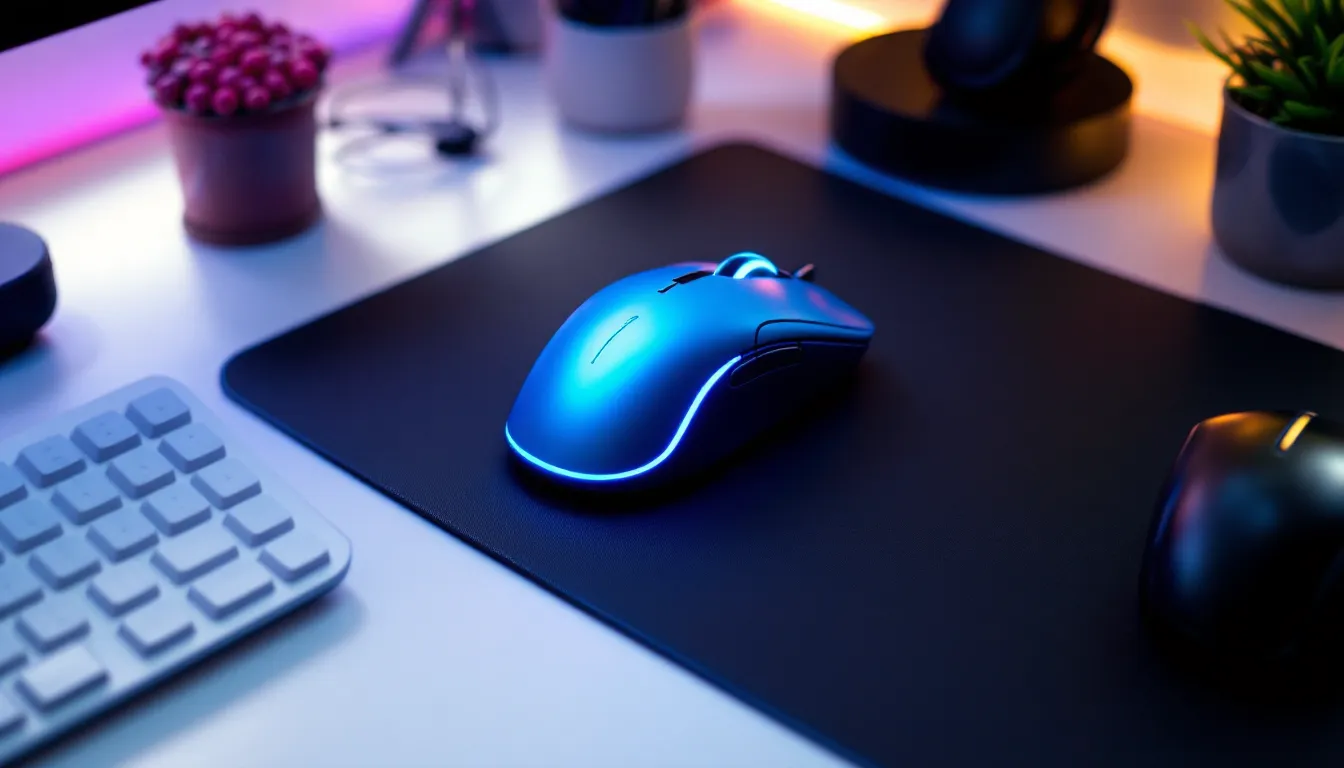
Shopping for a blue gaming mouse isn’t just about finding something that glows. Whether you’re building a themed setup or hunting for that perfect sensor and grip combination that happens to come with blue accents, the options in 2026 are better than ever. RGB tech has evolved to the point where “blue” can mean a static sapphire shell, customizable cyan underglow, or programmable waves that sync with your entire rig.
This guide cuts through the marketing noise. You’ll find specific models worth your money, the features that actually matter for different game genres, and the differences between budget picks and premium flagships. If you’ve been staring at product pages wondering whether to trust the sensor specs or RGB promises, you’re in the right place.
Key Takeaways
- A blue gaming mouse combines aesthetic appeal with practical performance, offering visual appeal that photographs better on streams than red or green alternatives while providing psychological benefits for sustained focus during long gaming sessions.
- Sensor technology, grip ergonomics, and weight are critical factors—prioritize a high-DPI optical sensor (16,000+ DPI), match the mouse shape to your grip style (palm, claw, or fingertip), and choose lightweight models under 60g for competitive FPS play.
- In 2026, wireless gaming mice deliver sub-1ms latency indistinguishable from wired performance, with battery life improvements making them viable for all playstyles, though wired mice remain lighter and cheaper for budget-conscious gamers.
- RGB customization matters more than a single color—look for independently controllable zones, blue spectrum hex value adjustability, and software syncing capabilities across brands like Razer Synapse, Logitech G HUB, and Corsair iCUE for seamless setup integration.
- Game genre shapes your mouse choice: FPS players need ultralight builds with precise sensors, MOBA/RTS gamers prioritize programmable side buttons for macro management, and sim racers benefit from ergonomic palm-grip designs for extended comfort.
- Proper maintenance—weekly sensor cleaning, timely mouse feet replacement, and firmware updates—extends your blue gaming mouse lifespan and maintains consistent performance that outperforms purchasing premium features you won’t use.
Why Choose a Blue Gaming Mouse?
Blue isn’t the default RGB choice anymore, it’s deliberate. Gamers pick blue mice for reasons that go beyond matching their keyboard or mousepad, though that’s certainly part of it.
Aesthetic Appeal and Gaming Setup Integration
Blue builds are having a moment. Whether you’re rocking an ice-themed setup with white and cyan tones or going for that cyberpunk vibe with electric blues and purples, a blue gaming mouse ties the desk together. Unlike red (which screams “gamer”) or white (which shows dirt instantly), blue hits a sweet spot: distinctive without being aggressive.
Most modern mice let you customize RGB zones independently. That means you can set the scroll wheel to deep blue, the logo to white, and the side grips to cyan gradients. Razer Chroma, Logitech LIGHTSYNC, and Corsair iCUE all support blue spectrum customization down to specific hex values. If you’re syncing across peripherals, blue wavelengths tend to photograph better on stream setups than reds or greens, which can blow out on webcams.
Psychological Benefits of Blue Lighting
There’s actual research behind color psychology in gaming environments, though it’s not magic. Blue light is associated with focus and calm, the opposite of red’s aggressive stimulation. For long grind sessions in MMOs or strategy games where you need sustained concentration without tilting, blue ambient lighting can help maintain that headspace.
That said, don’t expect blue LEDs to magically improve your KD. The effect is subtle and varies by person. Some competitive FPS players actually prefer minimal lighting to reduce distractions. But if you’re the type who gets hyped up or frustrated easily, a cooler blue setup might keep you steadier than pulsing red alerts every time you score a kill.
Key Features to Look for in a Blue Gaming Mouse
Color aside, a gaming mouse lives or dies by its internals. Here’s what separates the contenders from the RGB paperweights.
Sensor Technology and DPI Range
Optical sensors dominate 2026, and for good reason. The PixArt PAW3395 and Razer Focus Pro 30K are the current gold standards, offering up to 30,000 DPI with zero acceleration or smoothing. Most gamers never touch anything above 3,200 DPI, but headroom matters for 4K and ultrawide monitor setups.
Key specs to check:
- Max DPI: 16,000+ for future-proofing, but 800–1,600 is the competitive sweet spot for FPS
- IPS (inches per second): 450+ to avoid tracking failure on fast flicks
- Lift-off distance: 1-2mm is ideal: adjustable is better
- Polling rate: 1,000Hz minimum, though 4,000Hz and 8,000Hz options exist (diminishing returns past 1,000Hz for most players)
Ignore marketing claims about “true 1:1 tracking.” Every decent sensor has that now. Focus on whether the mouse lets you customize lift-off distance and has on-board memory for DPI profiles.
RGB Customization and Blue Lighting Options
Not all blue mice are created equal. Some have a single-zone blue LED that can’t change color. Others pack 10+ RGB zones with per-key addressable lighting.
What to look for:
- Static blue shells: Mice like the ASUS ROG Keris in Moonlight Blue have physical blue plastic. RGB is separate. Good for clean aesthetics.
- RGB zones: Check how many zones are independently controllable. Cheap mice might light the whole mouse one color: premium models let you set the logo, scroll wheel, side grips, and underglow separately.
- Software ecosystem: Can you sync with your keyboard and headset? Razer Synapse, Logitech G HUB, and Corsair iCUE dominate here.
- Brightness control: If you game in the dark, you need granular brightness adjustment. Some mice are blinding at minimum settings.
Many professional players rely on specific sensitivity settings to optimize their performance, and RGB profiles often sync with these configurations through software suites.
Ergonomics and Grip Styles
Your grip style dictates shape, not the other way around.
Palm grip: Full hand contact. Look for mice with pronounced humps and longer bodies. The Logitech G502 and Razer DeathAdder V3 Pro are classics. Weight matters less here since your whole palm stabilizes the mouse.
Claw grip: Arched fingers, palm contact at the base. You want a shorter body with a rear hump. The Zowie EC2 and Pulsar X2 fit this well. Medium weight (60-80g) is the sweet spot.
Fingertip grip: Minimal contact, all fingers. Go lightweight (under 60g) with a flat, symmetrical shape. Glorious Model O, Finalmouse UltralightX, and Zaunkoenig M2K are built for this.
Hand size matters too. Measure from the base of your palm to your middle fingertip:
- Small (< 17cm): 120-125mm mouse length
- Medium (17-19cm): 125-130mm
- Large (> 19cm): 130mm+
Don’t buy based on aesthetics if the shape doesn’t fit your grip. A gorgeous blue mouse that cramps your hand after 30 minutes isn’t worth it.
Wired vs. Wireless Blue Gaming Mice
The wired vs. wireless debate is mostly settled in 2026, but there are still tradeoffs.
Performance Considerations
Wireless latency is functionally zero on flagship models. Logitech’s LIGHTSPEED, Razer’s HyperSpeed, and Corsair’s SLIPSTREAM all deliver sub-1ms response times, indistinguishable from wired in blind tests. Competitive esports players use wireless mice now: that tells you everything.
The real performance question is weight. Wireless mice need a battery, adding 10-20g compared to wired equivalents. If you’re chasing ultralight builds (under 60g), wired options like the Finalmouse Starlight or Zaunkoenig M2K still dominate.
Wired advantages:
- No charging
- Slightly lighter
- Zero electromagnetic interference (extremely rare, but possible in crowded LAN environments)
- Often $20-40 cheaper
Wireless advantages:
- No cable drag
- Cleaner desk aesthetic
- Easier to move between setups
- Many support wired mode when charging
If you’re playing fast-paced FPS where every millisecond counts, the cable drag from even a paracord-modded wired mouse is more impactful than the 0.5ms latency of a good wireless connection. For gaming gear recommendations and in-depth comparisons, hardware review sites regularly benchmark wireless performance across different models.
Battery Life and Charging Options
Battery tech has improved dramatically. Expect these benchmarks:
- RGB off: 80-120 hours on mid-range wireless mice
- RGB on (medium brightness): 40-60 hours
- RGB on (max brightness, reactive effects): 20-30 hours
Charging methods:
- USB-C cable: Standard now. Most mice support passthrough so you can game while charging.
- Wireless charging dock: Logitech and Razer offer Qi-compatible docks. Convenient but adds $40-60 to the price.
- Battery swap: Rare in 2026. Logitech’s older G305 used AA batteries: most modern mice have integrated rechargeable cells.
Pro tip: If you’re grabbing a wireless mouse, pick one that charges via USB-C (not Micro-USB). You’re already carrying USB-C cables for your phone and controller, no need for extra clutter.
Some premium models (Logitech G502 X Plus, Razer Viper V3 Pro) support wireless charging mousepads. They’re expensive ($100+ for the pad alone), but if you never want to think about battery life, it’s the ultimate quality-of-life upgrade.
Top Blue Gaming Mouse Models in 2026
Here’s what’s worth buying right now, broken down by budget. Prices are USD and reflect typical street prices as of March 2026.
Budget-Friendly Options Under $50
Logitech G305 LIGHTSPEED ($39-45)
- 12,000 DPI HERO sensor
- Wireless with single AA battery (250-hour life, RGB off)
- 99g with battery (heavy by modern standards, but reliable)
- Limited RGB (logo only, blue available)
- Best for: Casual gamers who want solid wireless performance without premium pricing
Razer Viper Mini ($29-35)
- 8,500 DPI optical sensor
- Wired, ultra-lightweight (61g)
- Chroma RGB with full customization
- Smaller shape (ideal for small-to-medium hands, fingertip/claw grip)
- Best for: Budget-conscious FPS players who prioritize weight over wireless
ASUS TUF Gaming M3 ($25-30)
- 7,000 DPI sensor
- Wired, durable build (marketed as military-grade durability)
- Basic RGB (single zone, blue available)
- Ambidextrous shape
- Best for: Entry-level gamers who need something reliable that won’t break
Mid-Range Performers ($50-$100)
Logitech G502 X ($79-89)
- 25,600 DPI HERO 25K sensor
- Wired or wireless versions available
- LIGHTSYNC RGB with multiple zones
- Iconic shape with thumb rest and adjustable weight system (removed in X version for lighter build)
- 89g wireless, 79g wired
- Best for: Palm grip gamers who want versatility across game genres
Razer DeathAdder V3 ($69-79)
- 30,000 DPI Focus Pro sensor
- Wired, ultra-lightweight for its size (59g)
- Chroma RGB (logo and scroll wheel)
- Ergonomic right-handed shape, medium-to-large size
- Best for: Palm/claw grip FPS players who want a proven shape with cutting-edge sensor tech
Glorious Model D Wireless ($79-89)
- 19,000 DPI sensor
- Wireless (71 hours battery, RGB off)
- Honeycomb shell design (61g)
- Ergonomic right-handed shape
- Customizable RGB with Glorious CORE software
- Best for: Gamers who want lightweight wireless without spending premium prices
Premium Blue Gaming Mice ($100+)
Logitech G502 X Plus ($139-159)
- 25,600 DPI HERO 25K sensor
- Wireless with LIGHTSPEED and Bluetooth
- LIGHTSYNC RGB with POWERPLAY wireless charging support
- 106g (heavier than competitors, but feature-rich)
- Hybrid optical-mechanical switches (LIGHTFORCE)
- Best for: Gamers who want every feature and don’t mind the weight
Razer Viper V3 Pro ($149-159)
- 30,000 DPI Focus Pro sensor
- Wireless with HyperSpeed (90-hour battery, RGB off)
- Optical switches Gen-3 (90M click lifespan)
- 54g (one of the lightest wireless mice available)
- Minimal RGB (logo only, to save weight)
- Best for: Competitive FPS players who demand ultralight wireless with zero compromises
Finalmouse UltralightX ($189-249, limited drops)
- Custom PixArt sensor
- Wired, ultra-lightweight (under 50g)
- Limited RGB (static colors on some editions, including blue variants)
- Small-to-medium size, symmetrical
- Best for: Enthusiasts and collectors chasing the absolute lightest option (availability is inconsistent)
When evaluating these models, consider checking detailed peripheral reviews for hands-on testing and sensor performance benchmarks before committing to higher-end purchases.
Best Blue Gaming Mice by Game Genre
Different games reward different mouse traits. Here’s how to match your hardware to your main genres.
FPS and Competitive Shooters
What matters: Low weight, precise sensor, consistent shape.
FPS players need fast, repeatable flicks and tracking. Every gram counts when you’re making micro-adjustments 200 times per match.
Top picks:
- Razer Viper V3 Pro: 54g, 30K DPI sensor, ambidextrous. The gold standard for tac shooters like Valorant and CS2.
- Logitech G Pro X Superlight 2: 60g, HERO 25K sensor, wireless. Slightly heavier than the Viper but preferred by many pros for its shape.
- Razer DeathAdder V3: 59g wired option for palm grip players. Ergo shape is controversial in competitive circles but beloved by many.
DPI recommendations:
- Low-sens players (400-800 DPI): Prioritize large mousepads and low lift-off distance
- High-sens players (1,600-3,200 DPI): Focus on IPS rating and polling rate
Avoid heavy mice (100g+) in this category. The Logitech G502, while feature-rich, is too heavy for optimal FPS performance unless you exclusively palm grip and play slower tac shooters.
MOBA and Strategy Games
What matters: Programmable buttons, comfortable shape for long sessions, durable switches.
MOBA and RTS players don’t need ultralight builds. You’re clicking more than flicking, and extra buttons for item actives or control groups are crucial.
Top picks:
- Logitech G502 X Plus: 13 programmable buttons, comfortable palm grip shape, on-board profiles for switching between heroes/races.
- Razer Naga V2 Pro: 12-button side panel (MMO style, but works for MOBAs). Swappable side plates for 2, 6, or 12 buttons.
- Corsair Scimitar RGB Elite: Another 12-button option with mechanical switches and adjustable side panel.
DPI recommendations:
- 1,600-2,400 DPI is the sweet spot. You need precision for clicking units and UI elements, not flick shots.
Button mapping is critical. Use mouse software to bind:
- Item slots to side buttons
- Camera controls (for MOBAs)
- Control groups 1-3 (for RTS)
- Ping/communicate shortcuts
Racing and Simulation Games
What matters: Ergonomics, smooth tracking, adjustable DPI for UI navigation.
Sim racers spend less time with the mouse than other genres (you’re mostly on a wheel), but when you need it for menus, pit strategy, or camera controls, comfort matters.
Top picks:
- Logitech G502 X: Comfortable for extended use, adjustable DPI for switching between in-race camera control and UI navigation.
- Razer DeathAdder V3: Ergo shape reduces fatigue during long endurance events when you’re switching between wheel and mouse.
- ASUS ROG Chakram X: Joystick thumbstick option (niche, but some sim racers use it for camera control).
DPI recommendations:
- 800-1,200 DPI for general use. You’re not making fast movements, so prioritize comfort over speed.
Many sim racers use lower-tier mice since it’s not the primary input. A solid $40-60 option with good ergonomics often makes more sense than a $150 flagship.
How to Optimize Your Blue Gaming Mouse Settings
Buying the right mouse is half the battle. Tuning it properly is the other half.
DPI and Sensitivity Configuration
DPI (dots per inch) measures how far your cursor moves per inch of physical mouse movement. Higher isn’t better, it’s about finding your sweet spot.
How to find your optimal DPI:
- Start at 800 DPI (the most common competitive baseline)
- Launch your main game and adjust in-game sensitivity until a full mousepad swipe equals a 360-degree turn (for FPS) or comfortable screen coverage (for other genres)
- If you run out of mousepad space before hitting 360, increase DPI to 1,600 and halve in-game sens
- If 800 feels too fast, drop to 400 and double in-game sens
General guidelines:
- FPS (low-sens): 400-800 DPI, 30-50cm/360°
- FPS (high-sens): 1,600-3,200 DPI, 15-25cm/360°
- MOBA/RTS: 1,600-2,400 DPI
- Desktop/general use: 1,000-1,600 DPI
Most modern mice let you save multiple DPI profiles. Set up:
- Profile 1: Low DPI for FPS
- Profile 2: Medium DPI for desktop
- Profile 3: High DPI for fast camera movement or UI navigation
Switch via a dedicated DPI button (usually behind the scroll wheel).
Button Mapping and Macros
Don’t leave side buttons unmapped. Even simple binds improve efficiency.
Common useful mappings:
- FPS: Melee, grenade, ping, crouch toggle
- MOBA: Item actives (QWER are for abilities: side buttons for items prevent finger gymnastics)
- MMO: Rotation abilities, trinkets, mounts
- General: Copy/paste, browser forward/back, push-to-talk
Macro legality varies by game:
- Generally allowed: Single keystroke per click (binding “1” to a side button)
- Gray area: Multi-key combos (Ctrl+Shift+1) for complex actions
- Bannable: Automated sequences, recoil control scripts, rapid-fire loops
Most competitive games (Valorant, CS2, League, Dota 2) prohibit macros that automate actions. If you’re unsure, stick to single-action binds.
RGB Lighting Synchronization
RGB sync is easier than it used to be, but software ecosystems still matter.
If you have a single-brand setup (all Razer, all Logitech, all Corsair):
- Open the brand’s software (Synapse, G HUB, iCUE)
- Create a lighting profile
- Set all devices to the same effect (static blue, wave, reactive, etc.)
- Sync across devices with one click
If you have a multi-brand setup:
- Use third-party tools like SignalRGB or OpenRGB (free, supports 100+ devices)
- Create unified lighting profiles across brands
- Note: Not all devices are supported, and some features may be limited
Pro tip: Most software lets you tie lighting profiles to specific games. Set your blue wave effect to activate when you launch your main game, then revert to static blue for desktop use. Saves power and reduces distraction.
Maintenance and Care Tips for Your Blue Gaming Mouse
Gaming mice last longer when you treat them right. Here’s how to keep yours in competitive shape.
Weekly cleaning:
- Wipe down the shell with a microfiber cloth (slightly damp, not wet)
- Use compressed air to blow out dust from sensor lens and crevices
- Clean mouse feet with isopropyl alcohol (70%+) to remove grime buildup
Monthly deep clean:
- Remove mouse feet (if replaceable) and clean the sensor lens with a cotton swab and isopropyl alcohol
- For honeycomb shell mice, use a soft brush to clear debris from holes
- Check cable (if wired) for fraying near the connector
Cable management (wired mice):
- Use a mouse bungee to prevent cable drag and reduce strain on the connector
- Avoid sharp bends or kinks in the cable
- Paracord cables (aftermarket or stock) last longer than rubber-coated cables
Battery care (wireless mice):
- Don’t leave wireless mice uncharged for months (lithium batteries degrade when fully depleted)
- If storing long-term, charge to 50-70% before putting away
- Most modern mice have overcharge protection, but avoid leaving plugged in 24/7 if possible
Mouse feet replacement:
Mouse feet (or skates) wear out over time, creating friction and inconsistent glide. Replace when:
- You feel scratchiness or resistance on the mousepad
- Feet are visibly worn or uneven
- After 6-12 months of daily use
Aftermarket feet (PTFE, ceramic, or glass) from brands like Corepad or Tiger Gaming Arc offer smoother glide than stock feet on many mice. Blue mice with RGB underglow sometimes have specific feet shapes to accommodate lighting, double-check compatibility before buying replacements.
Software and firmware:
- Keep mouse software updated for bug fixes and new features
- Back up profiles and macros before major updates
- Most brands (Razer, Logitech, Corsair) support on-board memory, so profiles survive even if you uninstall software
Don’t use harsh cleaners (Windex, bleach-based products) on mice. They can damage coatings and RGB diffusers, especially on blue shells where discoloration is more visible.
Common Issues and Troubleshooting
Even the best mice act up occasionally. Here’s how to fix the most common problems.
Double-clicking / unintended clicks:
- Cause: Switch degradation (common on Omron switches after 10-20M clicks)
- Quick fix: Adjust debounce time in mouse software (if available)
- Permanent fix: Replace switches (requires soldering) or RMA the mouse if under warranty
- Prevention: Avoid slamming clicks: consider mice with optical switches (Razer Gen-3, Bloody, Roccat Titan) which don’t suffer mechanical wear
Cursor jitter or erratic movement:
- Cause: Dust on sensor lens, incompatible mousepad surface, or USB power issues
- Fix:
- Clean sensor lens with compressed air and isopropyl alcohol
- Test on a different surface (glossy desks and glass cause sensor issues)
- Try a different USB port (USB 3.0 ports sometimes cause interference: use USB 2.0)
- Lower lift-off distance in software
- Disable angle snapping or surface calibration features
RGB not working or flickering:
- Cause: Software conflict, outdated firmware, or faulty LED controller
- Fix:
- Reinstall mouse software (Synapse, G HUB, etc.)
- Update firmware via software
- Reset mouse to factory defaults (usually hold DPI button + right-click for 5 seconds, but check manual)
- If one zone is dead, it’s likely a hardware failure, RMA if under warranty
Wireless connectivity drops:
- Cause: Interference, low battery, or USB receiver placement
- Fix:
- Charge the mouse fully
- Move USB receiver closer (use extension cable if needed: many wireless mice include one)
- Avoid USB 3.0 ports and devices (they emit 2.4GHz interference)
- Update wireless firmware via software
- Check for competing 2.4GHz devices (routers, Bluetooth, wireless headsets)
DPI randomly changing mid-game:
- Cause: Accidental DPI button press or software bug
- Fix:
- Disable DPI button in software (or remap to something less intrusive)
- Lock DPI to a single setting if you don’t need profiles
- Check for software conflicts (some overlays or recording software interfere with mouse drivers)
Squeaky clicks or mushy buttons:
- Cause: Shell flex, loose switches, or lubrication wear
- Fix:
- Tighten shell screws (some mice have screws under mouse feet)
- Apply tiny amounts of dielectric grease to switch stems (advanced, can void warranty)
- RMA if under warranty
Most reputable brands (Logitech, Razer, Corsair) offer 2-year warranties. Don’t try to fix hardware issues yourself if you’re still covered, RMA and get a replacement.
Conclusion
A blue gaming mouse is more than just an aesthetic choice, it’s the centerpiece of a well-thought-out setup, whether you’re chasing ultralight performance for flick shots or need programmable buttons for MOBA macro management. The options in 2026 cover every budget and playstyle, from the $29 Razer Viper Mini to the $159 Viper V3 Pro.
The right pick depends on what you actually play. FPS players should prioritize weight and sensor quality. MOBA and RTS gamers need extra buttons and comfort for marathon sessions. And if you’re building a themed setup, don’t forget that RGB customization varies wildly, some “blue” mice only offer single-zone lighting, while others let you fine-tune every hex value.
Test grip styles before you commit, tune your DPI instead of blindly cranking it to max, and don’t skip maintenance. A clean sensor and fresh mouse feet make more difference than you’d think. Now go find your perfect blue match and start grinding.


