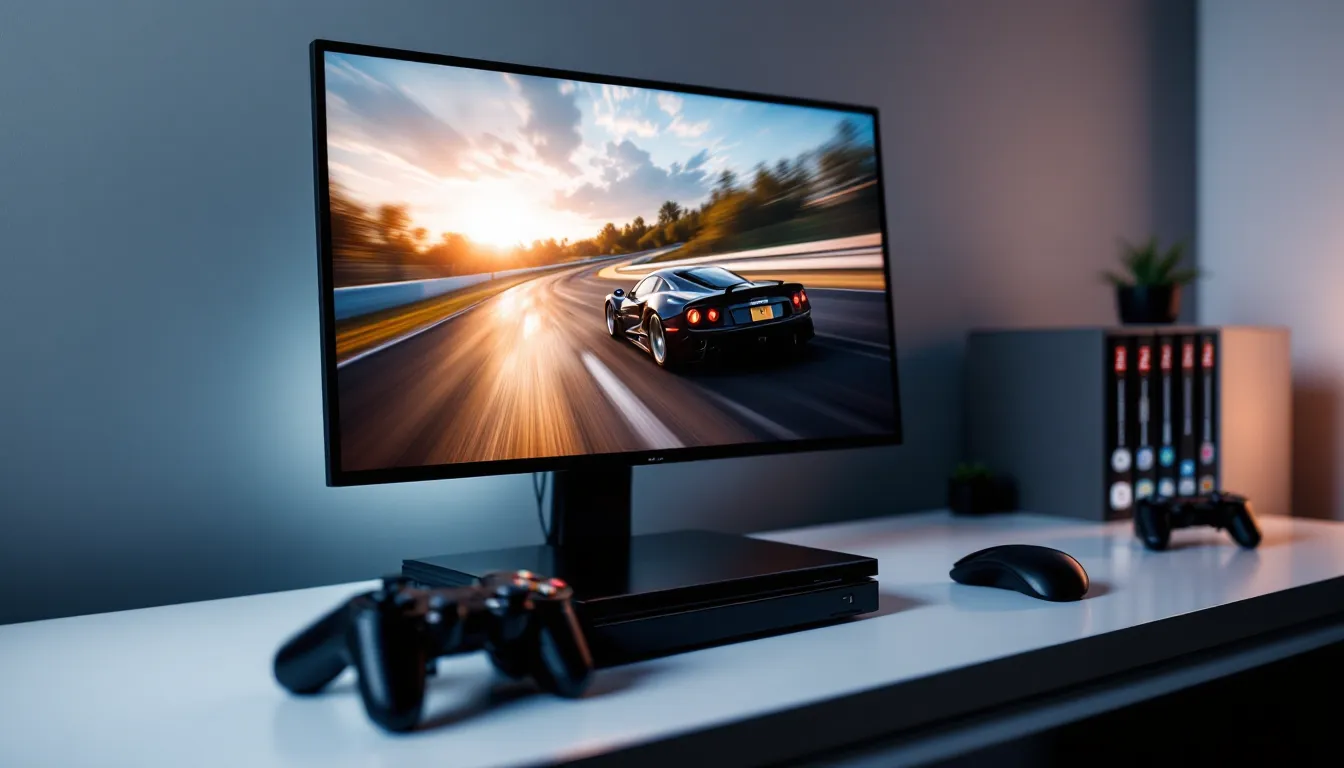
The PlayStation 2 wasn’t just a console, it was the definitive racing game machine of its generation. With over 155 million units sold worldwide, Sony’s sixth-gen powerhouse hosted an unprecedented library of racing titles that spanned every subgenre imaginable. From the surgical precision of Gran Turismo 4’s Nürburgring Nordschleife to the gloriously reckless carnage of Burnout 3: Takedown, the PS2 era delivered racing experiences that modern titles still struggle to replicate.
What made these games special wasn’t just raw horsepower. The best PS2 racing games combined innovative mechanics, genre-defining features, and that intangible sense of flow that kept you chaining laps until 3 AM on a school night. Whether you’re hunting for nostalgia or discovering these classics through emulation, this collection represents the peak of pre-HD racing, when developers squeezed every polygon out of the Emotion Engine and creativity mattered more than resolution counts.
Key Takeaways
- The best PS2 racing games combined innovative mechanics and genre-defining features that modern titles still struggle to replicate, particularly in single-player depth and content density.
- Gran Turismo 4 remains the gold standard simulation with 721 licensed cars, laser-scanned tracks, and a physics model that rewarded practice over expensive equipment, making it the definitive console racing experience.
- Burnout 3: Takedown and Revenge revolutionized arcade racing by making aggressive takedowns the core mechanic, paired with unmatched sense of speed and signature slow-motion crash replays.
- Need for Speed: Underground 2 and Most Wanted perfected street racing through extensive vehicle customization, open-world exploration, and progression systems that offered complete experiences without monetization.
- PS2 racing games remain playable today through original hardware or PCSX2 emulation, which upscales titles to 4K and reveals artistic detail invisible at native resolution.
- The PS2 racing library offered specialized experiences like Tourist Trophy for motorcycle sims, WRC games for rally authenticity, and ATV Offroad Fury for arcade off-road fun, creating niches absent in modern racing markets.
Why PS2 Racing Games Remain Legendary in 2026
Two decades after the PS2’s prime, its racing library still holds up, and not just through rose-tinted glasses. These titles benefited from a perfect storm of technological maturity and creative risk-taking that’s rare in modern AAA development.
The hardware itself deserves credit. By 2004-2005, studios had fully mastered the PS2’s architecture, extracting visual fidelity and performance that seemed impossible at launch. Gran Turismo 4 ran at native 1080i resolution with 700+ cars. Burnout Revenge maintained blistering speeds at 60fps while rendering traffic, rivals, and cascading destruction simultaneously.
But technical prowess alone doesn’t explain their staying power. The PS2 generation predated microtransactions, season passes, and always-online requirements. When you bought Need for Speed: Underground 2, you got the complete experience, no battle pass required. This design philosophy created tightly focused games where every feature earned its place through merit, not monetization.
The genre diversity also matters. Today’s racing market clusters around live-service sims and open-world racers. The PS2 offered specialized experiences: Tourist Trophy for motorcycle purists, ATV Offroad Fury for quad enthusiasts, WRC for rally fanatics. Each carved out its niche without chasing broader appeal.
Emulation has extended their relevance dramatically. PCSX2 can upscale these titles to 4K with texture filtering and widescreen patches, revealing artistic detail the original hardware couldn’t display. Many comprehensive racing game guides now treat PS2 classics as essential entries alongside contemporary releases.
Gran Turismo 4: The Definitive Simulation Experience
Polyphony Digital’s 2004 masterpiece remains the gold standard for single-player racing sims. With 721 cars spanning manufacturers from Toyota to TVR, plus 51 track layouts including laser-scanned reproductions of real circuits, GT4 offered unprecedented depth for console hardware.
What Makes Gran Turismo 4 Stand Out
The physics model struck an ideal balance between accessibility and realism. Unlike modern sims that require $500 wheel setups to feel natural, GT4’s handling worked beautifully on DualShock 2. Weight transfer affected grip realistically, braking distances matched real-world physics, and throttle control determined corner exit speed, but the learning curve rewarded practice instead of punishing beginners.
Gran Turismo Mode structured progression through a sprawling career. You started with used economy cars and license tests, gradually earning credits for better machinery. The endurance races, 24-minute versions of Le Mans, Nürburgring, and Tsukuba, tested consistency and tire management in ways most racers never attempted.
Photo Mode was revolutionary for 2004. Players could position their cars at any track location, adjust lighting, apply motion blur, and export high-resolution images. This feature spawned entire online communities dedicated to virtual automotive photography, a practice now standard in racing games.
The car list remains staggering: Group C prototypes, Trans-Am muscle, JGTC touring cars, Formula Gran Turismo open-wheelers, and everything between. Each vehicle featured accurate specifications, from the Suzuki Cappuccino’s 657cc three-cylinder to the Bentley Speed 8’s 4.0L twin-turbo.
Only the absence of online multiplayer and mechanical damage keeps GT4 from perfection. The AI, while competent, follows rigid racing lines and rarely adapts to player aggression. But as a single-player driving encyclopedia, it’s unmatched.
Burnout 3: Takedown – Adrenaline-Fueled Arcade Chaos
Criterion Games redefined arcade racing in 2004 by making aggression the core mechanic. Burnout 3 didn’t just allow you to wreck opponents, it required you to. The Takedown system rewarded slamming rivals into traffic, walls, and barriers with turbo refills and point bonuses, creating a feedback loop of automotive violence.
The sense of speed was unmatched. Boost chains could sustain 200+ mph through city streets, with the camera pulling back and motion blur intensifying to communicate velocity. When crashes occurred, the game’s signature slow-motion replays showed every panel deformation and spinning hubcap in glorious detail.
Crash Mode and Aggressive Racing Mechanics
Crash Mode transformed accidents into puzzle challenges. You launched vehicles into busy intersections, aiming to cause maximum monetary damage through chain reactions. Strategic use of the Crashbreaker, an explosive boost triggered mid-wreck, could redirect your tumbling car into fuel tankers or buses for multiplier bonuses.
Each of the 100+ events had specific targets: $2 million in damage, takedown 5 rivals, maintain a boost chain for 30 seconds. The variety prevented repetition across the substantial campaign. Unlocking new vehicles required medals, and gold-tier performance demanded memorizing traffic patterns and optimal takedown locations.
Multiplayer supported split-screen chaos that defined PS2-era couch gaming. Four players competing in Crash Mode junctions or Road Rage takedown counts delivered endless replayability. The simplified controls, accelerate, brake, boost, takedown, made it accessible for non-racing fans while maintaining depth through risk-reward boost management.
The licensed soundtrack leaned hard into punk and alternative rock: Yellowcard, Barenaked Ladies, Franz Ferdinand. Songs synced with gameplay intensity, elevating during boost chains and fading during crashes. It’s a time capsule of mid-2000s gaming culture, and it still hits.
Need for Speed: Underground 2 – Street Racing at Its Peak
EA Black Box’s 2004 sequel perfected the underground racing formula with extensive customization and open-world exploration. Set in the fictional Bayview, NFSU2 combined circuit races, drifting, drag racing, and URL competitions into a cohesive career spanning 120+ events.
The customization depth was absurd for its time. Beyond performance upgrades (ECUs, turbochargers, nitrous), you could modify nearly every visual element: body kits, spoilers, hoods, side skirts, roof scoops, neon underglow, vinyl wraps, window tinting, hydraulics, and even trunk-mounted subwoofers that pulsed to the soundtrack. The dyno tuning system let you adjust gear ratios and suspension geometry, adding simulation-lite depth beneath the arcade handling.
Customization and Open-World Exploration
Bayview’s open structure let you cruise between events, discover hidden races, and hunt for performance shops. Five districts, City Core, Coal Harbor, Jackson Heights, Beacon Hill, and Airport, each had distinct architectural styles. Magazine covers scattered throughout the world unlocked additional parts when photographed, encouraging exploration beyond waypoint-following.
Drift events judged style over speed, rewarding sustained angle and proximity to barriers. The Unique Performance parts system gated the best upgrades behind specific sponsor challenges, creating meaningful progression. You couldn’t just grind cash, you needed to complete drift challenges for HKS turbos or drag races for AEM performance parts.
The car roster emphasized import tuners: Nissan Skyline GT-R R34, Mazda RX-7, Toyota Supra, Mitsubishi Lancer Evolution VIII. Each handled distinctly, the Skyline’s AWD grip contrasted with the RX-7’s oversteer-happy balance. Finding your preferred chassis and build style became part of the game’s identity.
Online communities still debate the ideal Street X builds for circuit domination. The meta typically favored lightweight imports with turbo level 3, ECU stage 3, and NOS for straightaway advantage, though Bayview’s tight hairpins rewarded handling-focused setups.
Midnight Club 3: DUB Edition – Urban Racing Redefined
Rockstar San Diego’s 2005 entry delivered the most aggressive open-world street racing on PS2. While Need for Speed focused on tuner culture, Midnight Club 3 embraced hip-hop aesthetics, muscle cars, and consequence-free urban chaos across Atlanta, Detroit, and San Diego.
The DUB branding (referencing the magazine and 20″+ wheels) shaped the visual customization. Forgiato rims, candy paint finishes, lambo doors, and hydraulic setups transformed vehicles into rolling hip-hop videos. But beneath the bling, the handling model required precision. Zone slow-motion mode could dodge traffic or nail corners, but limited charges made it a strategic resource, not a crutch.
Vehicle Variety and City Design
The 60+ vehicle roster spanned categories rare in racing games: luxury sedans (Cadillac Escalade, Hummer H2), choppers (West Coast Choppers customs), muscle cars (1970 Plymouth Barracuda, Dodge Charger), and sport bikes. Each class raced separately in career mode, preventing the homogenization that plagued other open-world racers.
Atlanta’s sprawling highways contrasted with Detroit’s industrial shortcuts and San Diego’s coastal routes. The cities connected into a massive combined map after career progression, creating hundreds of miles of drivable roads. No loading screens interrupted transitions between districts, a technical achievement for 2005 hardware.
Multiplayer supported 8-player online races with full vehicle customization and city exploration. The extensive motorcycle racing coverage from contemporary reviews highlighted Tourist Trophy as the simulation counterpart to Midnight Club 3’s arcade bike handling.
Special ability customization let you equip three powers: Agro (ramming strength), Roar (intimidation knockback), or Zone (bullet time). Mixing abilities for different race types added meta-game depth. Circuit races favored Zone for corner precision, while Unordered Checkpoints races rewarded Agro for traffic clearing.
Need for Speed: Most Wanted – The Perfect Blend of Cops and Racing
EA Black Box’s 2005 masterpiece fused Underground’s customization with high-stakes police pursuits. Set in the fictional Rockport City, Most Wanted built its career around the Blacklist, 15 ranked street racers you defeated sequentially to reclaim your stolen BMW M3 GTR.
The narrative hook worked. Your opening race against Razor results in sabotage and arrest, stripping your ride and reputation. Rebuilding from a borrowed Cobalt SS to exotic territory while evading increasingly aggressive cops created genuine investment rare in racing games.
Police Pursuit System and Blacklist Progression
The Heat Level system escalated police response across six tiers:
- Heat 1-2: Standard patrol units with basic pursuit tactics
- Heat 3-4: Aggressive interceptors, roadblocks, spike strips deployed
- Heat 5: SUVs, cross-intersection blocks, helicopter tracking
- Heat 6: Corvette interceptors, multiple helicopters, city-wide coordination
Pursuits became strategic. Pursuit Breakers, environmental objects you triggered to block cops, scattered throughout Rockport. Slamming through a water tower or gas station to bury chasing Crown Vics under debris never got old. But higher heat levels meant reinforcements arrived faster, and totaling your car meant impound fees that could bankrupt your garage.
Bounty accumulated during pursuits became career currency. Higher bounty unlocked Blacklist challenges, creating a risk-reward loop: extend pursuits for more bounty but risk car damage and impound, or escape early with smaller rewards. Balancing this tension while managing nitrous and cooldown timing defined the game’s flow.
The car roster leaned exotic: Lamborghini Murciélago, Mercedes-McLaren SLR, Porsche Carrera GT. But the progression let you dominate early-list rivals with heavily modified lower-tier machines. A fully-tuned Mitsubishi Eclipse could compete against stock BMWs through superior handling and nitrous deployment.
Blacklist boss cars became pink slips after victories, though many had fixed visual modifications you couldn’t alter. Razor’s M3 GTR, the game’s holy grail, returned only in the final race, its V8 soundtrack distinct from every other vehicle.
Burnout Revenge: Aggressive Racing Evolved
Criterion’s 2005 follow-up to Takedown refined the formula while adding controversial mechanics. Traffic Checking, the ability to slam same-direction vehicles into rivals, divided the fanbase but undeniably ramped up aggression.
The visual upgrade was noticeable even on PS2 hardware. Environments featured more destructible elements, crash deformations intensified, and the Crashbreaker explosions became even more over-the-top. The game maintained Burnout 3’s 60fps target while rendering more on-screen chaos, showcasing Black Box’s technical mastery.
Crashbreaker Racing events added strategic depth. Instead of traditional races, crashed vehicles could detonate to wreck nearby rivals, turning mistakes into offensive weapons. Positioning your wreck near a pursuing pack before triggering the explosion required spatial awareness and timing.
The 169 events across 11 venue types prevented monotony: standard races, Road Rage, Traffic Attack (wreck civilian vehicles), Burning Lap time trials, and the signature Crash junctions. Each vehicle class, Compact, Muscle, Sports, Super, Race Specials, handled distinctly, rewarding adaptation.
Critic opinions remain split on Traffic Checking. Purists argue it lowered the skill ceiling by reducing traffic avoidance. Defenders claim it streamlined the flow, keeping momentum during boost chains. Playing both Takedown and Revenge back-to-back reveals two valid design philosophies, Takedown’s precision versus Revenge’s relentless aggression.
The licensed soundtrack leaned heavier into alternative rock than Takedown, featuring Fall Out Boy, My Chemical Romance, and Yellowcard. “Angels & Airwaves’ The Adventure” became synonymous with Crash Mode highlight reels.
Tourist Trophy: Motorcycle Racing Excellence
Polyphony Digital applied the Gran Turismo formula to two wheels in 2006, creating the definitive motorcycle sim for consoles. Built on the GT4 engine, Tourist Trophy delivered 116 licensed bikes across sport, touring, naked, and endurance categories, plus the same track roster, Nürburgring, Suzuka, Laguna Seca, and original circuits.
The physics model captured motorcycle-specific dynamics absent from other racers. Weight transfer during braking compressed front suspension, affecting turn-in. Throttle application mid-corner could highside or lowside depending on lean angle and traction. Counter-steering required conscious input for high-speed direction changes, just leaning wasn’t enough.
Body positioning became an additional control layer. You manually shifted rider weight forward during braking, backward during acceleration, and inward during cornering. This three-dimensional input created a connection to the bike unmatched by car-based racers. Mastering the Nürburgring’s Carousel required specific body positioning to maintain speed while leaned over at 50+ degrees.
Tourist Trophy Mode mirrored GT4’s career structure with license tests, manufacturer challenges, and endurance events. The Isle of Man TT course, 37.73 miles of public roads, appeared as the ultimate test, demanding memorization of hundreds of corners without traditional racing circuit safety margins.
The bike roster emphasized Japanese sportbikes but included Ducati’s superbikes, Harley-Davidson’s V-Rods, and BMW’s touring machines. A fully-tuned Suzuki GSX-R1000 could hit 210+ mph on the Test Course, while vintage 1970s two-strokes offered torque-challenged handling challenges.
Photo Mode returned with motorcycle-specific options. Capturing a rider mid-lean through Suzuka’s 130R or launching off the Corkscrew at Laguna Seca created wallpaper-worthy images that showcased Polyphony’s attention to detail.
ATV Offroad Fury Series: Off-Road Multiplayer Mayhem
Rainbow Studios’ ATV Offroad Fury franchise owned the off-road niche with four PS2 entries between 2001-2006. These weren’t simulation-focused, they prioritized arcade fun, huge jumps, and 4-player split-screen chaos.
ATV Offroad Fury 2 (2002) hit the sweet spot with 20+ vehicles, expansive outdoor environments, and trick systems borrowed from Tony Hawk’s Pro Skater. Chaining backflips, supermans, and can-cans while maintaining racing lines created flow-state gameplay. The Pro Career mode required balancing race wins with freestyle medal scores across 40+ events.
Physics leaned toward accessible arcade handling. Quad bikes had unrealistic suspension travel and sticky traction, but this served the gameplay. Landing 50-foot jumps without realistic consequences kept momentum high. The Preload mechanic, compressing suspension before jumps, added skill expression for maximizing airtime.
ATV Offroad Fury 3 (2004) added mini-games like hockey, basketball, and tag modes playable with ATVs. These never replaced core racing but offered variety during multiplayer sessions. The vehicle roster expanded to include dune buggies and MX bikes, though purists stuck with traditional quads.
Online multiplayer (via PS2’s network adapter) supported 12-player races with voice chat, cutting-edge for 2004 console gaming. The community organized freestyle competitions and time trial leaderboards, extending replayability beyond the campaign.
The series never achieved mainstream recognition outside its dedicated niche, but for quad enthusiasts, it delivered experiences unavailable elsewhere. The physics felt specific to ATVs, how they slid through loose dirt, kicked sideways during hard landings, and required weight shifting mid-air for trick cancellation.
Other Notable PS2 Racing Gems Worth Playing
Beyond the headliners, the PS2 library featured specialized racers that deserve attention from genre enthusiasts. These titles didn’t achieve blockbuster status but offered unique experiences unavailable in today’s market.
WRC Rally Games
Evolution Studios’ WRC series (2001-2005) delivered authentic rally racing across five annual releases. Licensed from the FIA World Rally Championship, these games featured real stages, official drivers (Sébastien Loeb, Marcus Grönholm), and accurate vehicle specifications for Group A, WRC, and Super 1600 classes.
WRC 4 (2004) represented the peak. The pace note system conveyed corner severity through co-driver callouts, “Left 3 tightens to Left 2”, requiring anticipation instead of reaction. Surface degradation meant early starting positions faced pristine gravel while late runners dealt with rutted lines. Weather transitions mid-stage affected grip dynamically.
The detailed rally game analysis from the era highlighted WRC’s simulation depth compared to arcade alternatives. Damage modeling affected handling progressively, losing a wheel meant limping to service, not instant retirement. Handbrake technique for Scandinavian flicks and left-foot braking for weight transfer became essential skills.
Initial D: Special Stage
Sega’s 2003 port of the arcade touge racer brought anime-licensed drifting to PS2. Based on the manga/anime franchise, Initial D focused exclusively on mountain pass battles (touge) with emphasis on drift technique over raw speed.
The handling model rewarded momentum preservation through linked corners. Overslowing killed lap times: maintaining flow through precise drift angle and throttle modulation separated veterans from rookies. The Gutter Run technique, riding the inner drainage gutter through specific corners, offered risk-reward shortcuts that required pixel-perfect positioning.
The car roster matched the source material: AE86 Trueno, FD RX-7, EG6 Civic, R32 Skyline GT-R. Each protagonist vehicle came with signature battle music and rival matchups. Unlocking extra stages and time attack modes provided lasting challenge beyond the story campaign.
Auto Modellista
Capcom’s 2002 cell-shaded racer divided opinions with its visual style but delivered solid arcade racing underneath. The anime-inspired graphics, thick outlines, vibrant colors, looked unlike anything else in the genre. Some found it charming: others called it a gimmick.
The Garage Life mode emphasized tuning and visual customization. Performance upgrades affected handling noticeably, swapping to sport tires improved grip but reduced straight-line stability. The drift-heavy physics favored Japanese sports cars, though American muscle and European exotics appeared in the 60+ vehicle roster.
Multiplayer split-screen supported 2 players with minimal framerate sacrifice. The track design featured original circuits with elevation changes and technical sections that punished poor braking points. It’s a curiosity worth experiencing for its art direction alone, even if the gameplay doesn’t revolutionize the genre.
How to Play PS2 Racing Games Today
Experiencing these classics in 2026 requires choosing between authentic hardware or emulation. Both paths have merits depending on priorities, preservation versus enhancement.
Original Hardware vs. Emulation
Running on authentic PS2 hardware delivers the intended experience. A refurbished fat-model PS2 costs $80-150 depending on condition. Component cables ($15-30) enable 480p output for compatible titles like Gran Turismo 4, though most racers max out at 480i. CRT televisions eliminate latency and display interlacing properly, but sourcing working sets grows harder annually.
Disc condition matters. PS2 used DVD-based media susceptible to disc rot and scratching. Inspect used copies carefully, surface damage causes texture pop-in and loading errors in racing games where streaming assets is constant. The FreeMcBoot soft-mod enables backup loading from HDD or OPL (Open PS2 Loader), preserving physical discs from wear.
PCSX2 emulation transforms these games visually while introducing minor compatibility quirks. Version 1.7.0 (stable) or the 2.0 nightly builds handle racing titles well, though shader accuracy varies by game. Recommended settings for best racing game performance:
- Internal Resolution: 3x-6x native (1080p to 4K depending on GPU)
- Anisotropic Filtering: 16x for sharper textures
- MTVU Hack: Enabled for performance boost
- Widescreen Patches: Available for most major racers
- 60fps Patches: Gran Turismo 4, Tourist Trophy benefit significantly
Burnout games hit 60fps natively and scale beautifully to 4K. Need for Speed titles benefit from texture filtering that eliminates muddy backgrounds. Gran Turismo 4 in 4K with 16x anisotropic filtering looks shockingly modern, the car models reveal detail invisible at native resolution.
Controller latency becomes critical for racing games. Wired DualShock 2 via USB adapter introduces 5-10ms input lag. Native PS4/PS5 controllers via DsHidMini drivers reduce lag to ~3ms. Dedicated racing wheels (Logitech G29/G923) work through emulation with LilyPad plugin configuration, though force feedback support varies by title.
Legal considerations: Emulation itself is legal: BIOS files must be dumped from your own PS2 hardware. Game ISOs fall into gray area, backups of owned discs are defensible, downloading ROMs isn’t. The ethical path involves ripping your physical collection using tools like ImgBurn.
Save file transfers work both directions. PS2 memory card files (.ps2 format) import to PCSX2’s virtual memory cards, preserving your GT4 garage or Most Wanted career. This lets you bounce between hardware and emulation without losing progress.
Conclusion
The best racing games for PS2 succeeded because studios prioritized tight mechanics and player value over live-service monetization. Gran Turismo 4’s 721-car roster didn’t require loot boxes. Burnout 3’s Crash Mode wasn’t carved out as paid DLC. Need for Speed: Underground 2 delivered complete customization systems at launch.
This design philosophy created games that still feel generous in 2026. Load up any title from this list and you’re immediately racing, no battle passes, no server queues, no day-one patches. The content density per dollar spent remains staggering compared to modern equivalents.
Emulation has given these classics renewed relevance. PCSX2’s upscaling capabilities reveal artistic detail the original hardware couldn’t display, while widescreen patches and 60fps mods enhance playability without compromising the core experience. For those who never owned a PS2, these titles remain accessible and worth experiencing.
Whether you’re chasing licenses in Tourist Trophy, triggering Crashbreakers in Burnout Revenge, or climbing Most Wanted’s Blacklist, the PS2 racing library offers something for every driving preference. These games don’t just survive on nostalgia, they remain legitimately great racing experiences that modern titles struggle to surpass in ambition and mechanical depth.


